
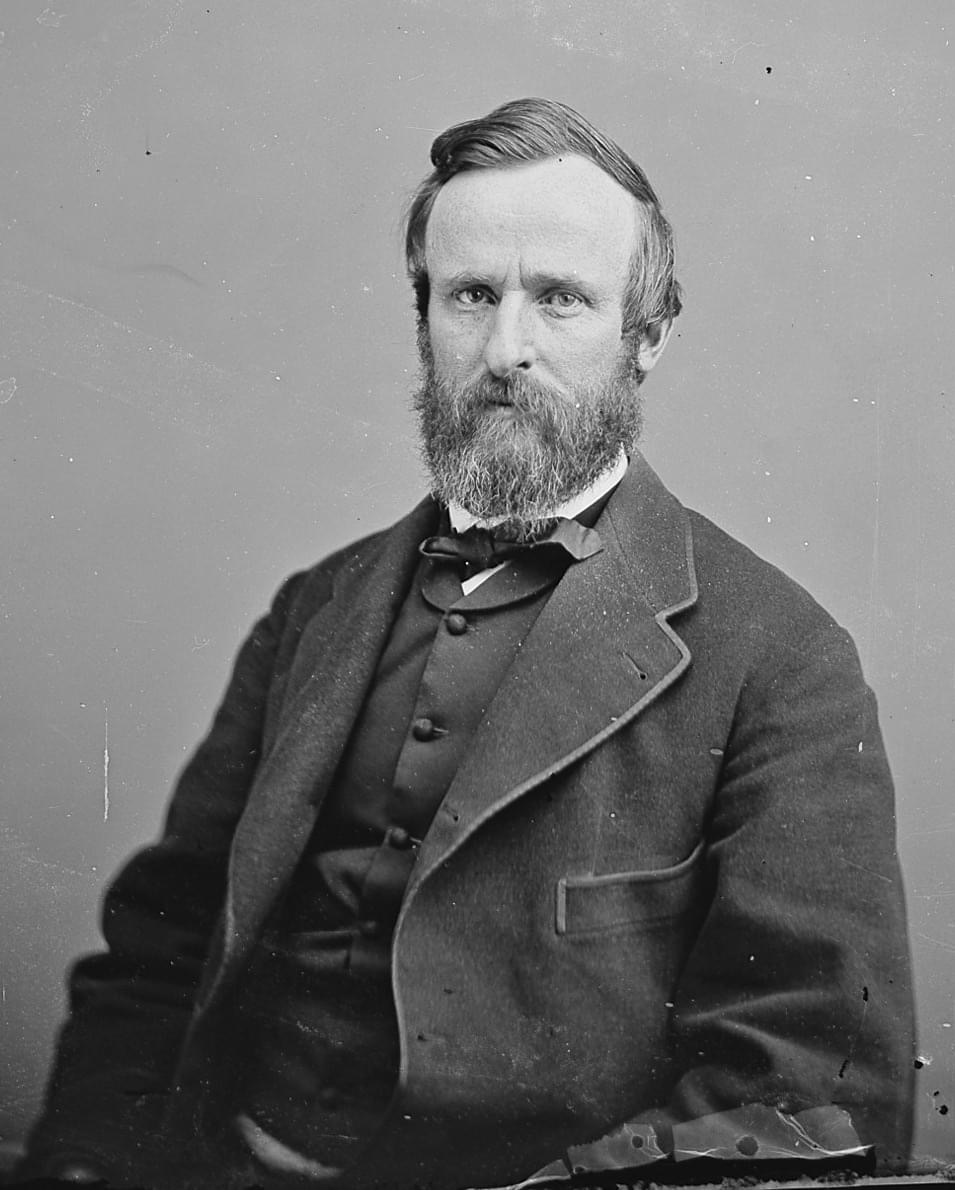
On October 4, 1822, Rutherford Birchard Hayes—the 19th president of the United States—was born in Delaware, Ohio. A standout student, Hayes graduated at the head of his class from Kenyon College before earning his law degree from Harvard. He built a successful legal career and later served with distinction as a Union officer during the Civil War, sustaining five wounds and ultimately receiving a brevet promotion to major general.
Hayes entered the presidency after the fiercely disputed election of 1876, at a moment when the nation remained deeply divided by the Civil War and its aftermath. His administration pursued civil-service reform, supported a return to sound-money policies, and withdrew the remaining federal troops from the South—an action that effectively ended Reconstruction. Although Hayes presented this policy as restoring local self-government, the end of Reconstruction also weakened federal protection of Black Americans’ civil and political rights in the former Confederate states.
In his December 1878 annual message to Congress, Hayes expressed confidence in the country’s capacity to recover from economic and political strain, declaring: “Let the healing influence of time, the inherent energies of our people, and the boundless resources of our country have a fair opportunity, and relief from present difficulties will surely follow.”
Hayes’s presidency did not resolve the nation’s deepest postwar conflicts, but it helped define the transition from Reconstruction to the Gilded Age. His efforts to curb patronage and promote merit in federal appointments also contributed to the later movement for permanent civil-service reform.
Image credit: Archival portrait photograph of Rutherford B. Hayes, via Wikimedia Commons, public domain.
