
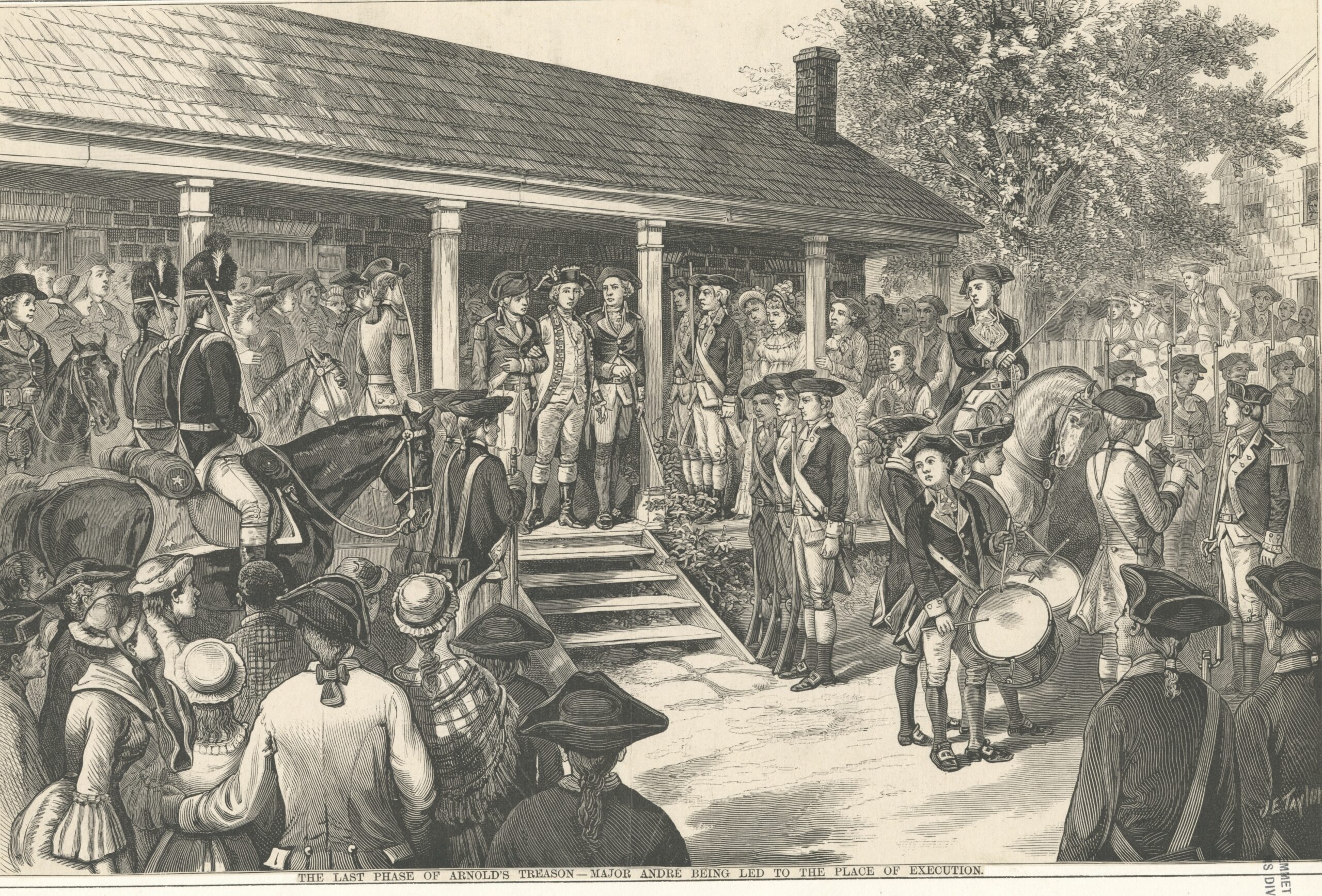
Around noon on October 2, 1780, British Army Major John André was hanged on an eminence near Tappan, New York, bringing to an end one of the American Revolution’s most consequential espionage conspiracies. As the British Army’s adjutant general and a leading intelligence officer in North America, André had negotiated with American Major General Benedict Arnold over the planned surrender of the strategically vital fortress at West Point. Captured behind American lines with papers concealed in his boots detailing West Point’s defenses and Arnold’s proposed arrangements, André was left to face the consequences of a plot from which Arnold escaped to British protection.
A board of fourteen senior Continental Army officers, presided over by Major General Nathanael Greene, concluded that André had entered American lines under an assumed name and in disguise and therefore must be treated as a spy. Under the law and usage of war, it recommended that he suffer death. General George Washington approved the judgment after efforts to exchange André for Arnold failed.
A large crowd gathered for the execution, alongside a solemn procession of Continental Army officers. André met the occasion with composure, though he was deeply distressed on learning that he would be hanged rather than shot—a form of execution he had requested as more fitting for a professional soldier. According to Continental Army surgeon James Thacher, André placed the noose around his own neck, without assistance from the executioner, and was offered an opportunity to speak. He briefly raised the handkerchief covering his eyes and declared: “I pray you to bear me witness that I meet my fate like a brave man.”
André was buried beneath or near the gallows at Tappan. In 1821, his remains were returned to Britain and reinterred in Westminster Abbey, where he is commemorated today. His death—viewed by Americans as the lawful punishment of a spy and by many Britons as the tragic end of a gifted officer—became one of the Revolution’s most enduring episodes of war, loyalty, and treason.
Image credit: Portrait of Major John André, via Wikimedia Commons, public domain.
