
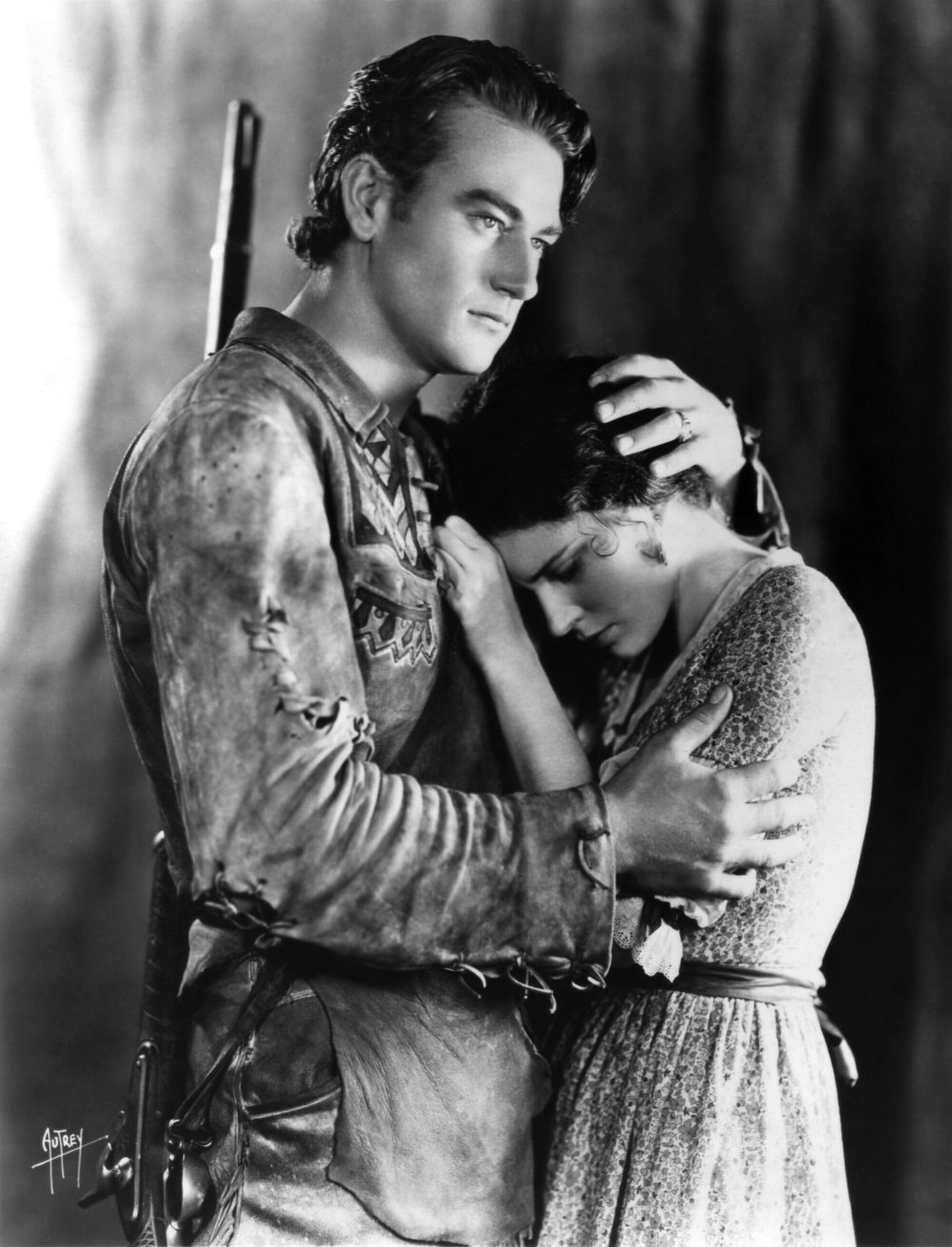
American film history took a notable turn on October 2, 1930, when Raoul Walsh’s epic pre-Code Western The Big Trail premiered at Grauman’s Chinese Theatre in Los Angeles. Produced by Fox Film Corporation, the ambitious production gave 23-year-old Marion Morrison—then working at Fox and newly rechristened John Wayne—his first starring role.
Wayne played Breck Coleman, a determined young scout and fur trapper who leads a wagon train of settlers westward while pursuing the men responsible for the death of a friend. The role introduced qualities that would later become central to Wayne’s screen image: physical presence, restraint, self-reliance, and moral purpose.
The Big Trail was among the most technically ambitious films of the early sound era. It was filmed on location across the American West, with the production traveling through seven states, and was photographed simultaneously in standard 35mm and Fox’s experimental 70mm Grandeur widescreen process. Fox also made separate Spanish-, French-, Italian-, and German-language versions with different casts, an immense logistical undertaking before dubbing became standard practice.
Although the picture did not succeed commercially on its original release—partly because few theaters were equipped to project the costly Grandeur format—its reputation has grown substantially over time. It launched Wayne’s long screen career and remains an important landmark in early widescreen filmmaking. In 2006, the Library of Congress selected The Big Trail for the National Film Registry as “culturally, historically, or aesthetically significant.”
Image credit: John Wayne promotional portrait for The Big Trail, via Wikimedia Commons, public domain.
