
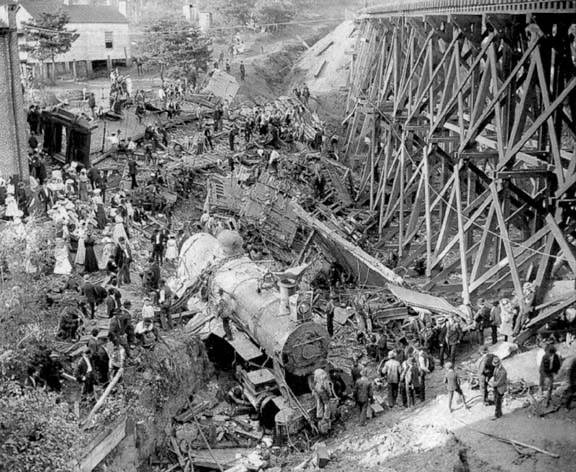
Behind one of country music’s most famous ballads lies a real disaster shaped by the pressure to keep a mail train on schedule.
On September 27, 1903, Southern Railway’s Fast Mail, known as Old 97, was running late on its route from Monroe, Virginia, to Spencer, North Carolina. Engineer Joseph “Steve” Broady attempted to make up time as the train approached Danville. Accounts differ on exactly how fast it was traveling, but all agree that it entered the steep descent toward Stillhouse Trestle at a dangerously excessive speed.
Unable to slow sufficiently for the sharp curve near the trestle, the locomotive and its cars left the rails and plunged into the ravine below. Eighteen railroad and postal employees were aboard; nine died at the scene, two later died of their injuries, and seven were injured.
The wreck inspired several ballads, but Vernon Dalhart’s 1924 recording of “The Wreck of the Old 97,” backed with “The Prisoner’s Song,” became country music’s first million-selling record. Its stark account of speed, duty, and catastrophe helped turn a local tragedy into a foundational story of American popular music.
Image via Wikimedia Commons; public domain in the United States.
