
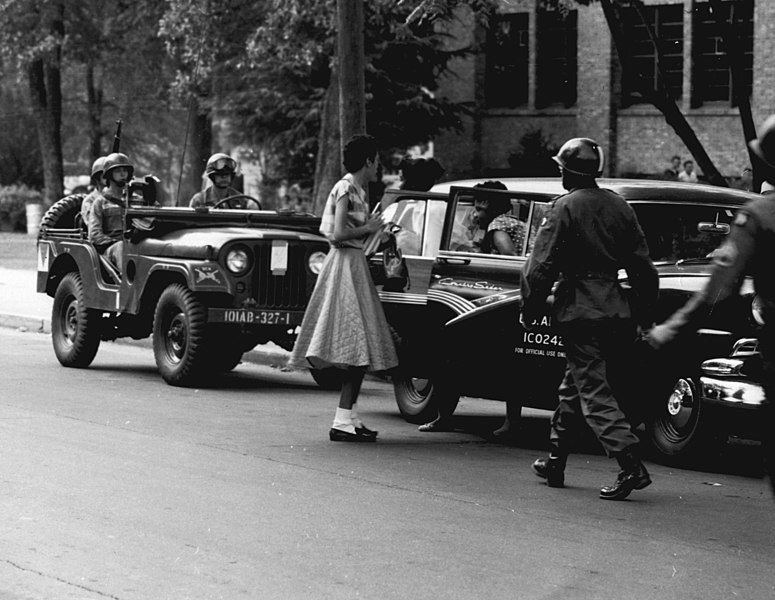
On September 25, 1957, the crisis over civil rights and public education reached a historic turning point when soldiers from the U.S. Army’s 101st Airborne Division escorted nine Black students into Little Rock Central High School in Arkansas. Their entry marked a decisive federal intervention by President Dwight D. Eisenhower to enforce federal court-ordered school desegregation following the Supreme Court’s landmark Brown v. Board of Education decision.
The deployment followed weeks of defiance by Arkansas Governor Orval Faubus. Earlier that month, Faubus had ordered the Arkansas National Guard to prevent the students—later known as the Little Rock Nine—from entering the previously all-white school. White mobs also gathered at the school and threatened violence, making clear that state authorities were obstructing a federal court order rather than protecting the students’ access to education.
On September 24, Eisenhower issued Executive Order 10730, federalized the Arkansas National Guard, and ordered elements of the 101st Airborne Division into Little Rock. The following morning, the Little Rock Nine entered Central High under armed federal escort for their first full day of classes. More than 20 101st Airborne soldiers accompanied them through the front entrance, while additional troops secured the campus perimeter.
Images and broadcasts of the confrontation reached audiences across the United States and abroad, exposing the violence and entrenched racism behind resistance to desegregation in the Jim Crow South. The students endured continuing harassment and abuse inside the school, even with military protection. The 101st Airborne withdrew later that fall, but the federalized Arkansas National Guard remained to help protect the students through the school year.
Eisenhower’s action demonstrated that state officials could not defy federal court rulings with impunity. It became one of the most consequential early federal interventions of the modern civil-rights era, showing that the national government was prepared to use executive authority and federal troops to uphold constitutional rights and enforce desegregation orders.
Image credit: U.S. Army photograph, via Wikimedia Commons. Verify the specific file’s license and attribution requirements before publishing; “public domain in the United States” and “CC BY 2.0” are different licensing designations.
