
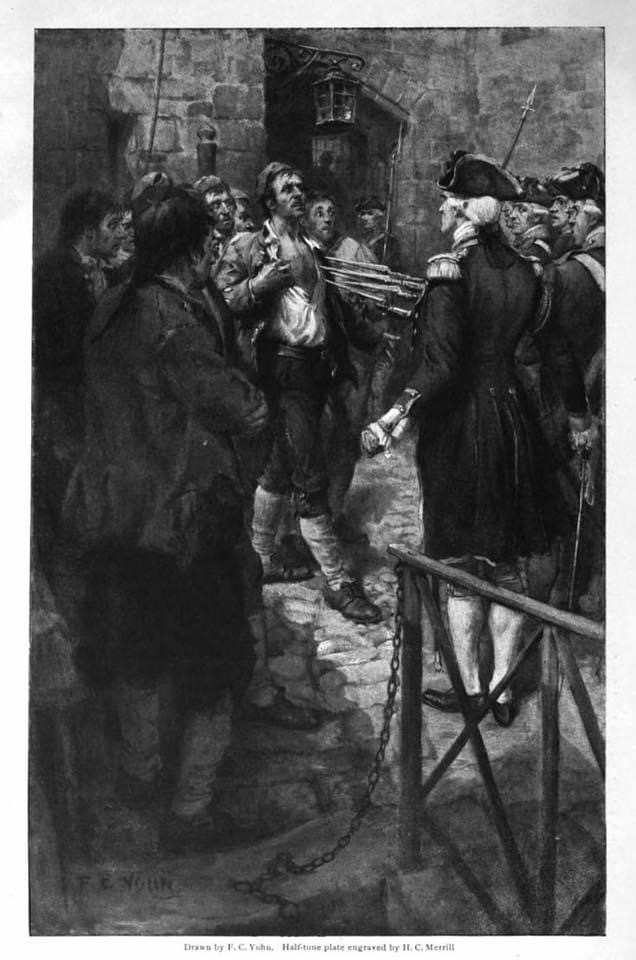
On September 25, 1775, during the opening months of the American Revolutionary War, Ethan Allen was captured by British forces after leading a premature and unsuccessful attack near Montreal. Only months earlier, Allen and Benedict Arnold had helped seize Fort Ticonderoga, a dramatic early Patriot victory. In Canada, however, Allen’s boldness proved costly.
While General Richard Montgomery’s army besieged St. Johns, Allen and Major John Brown recruited Canadian supporters and conceived a risky two-pronged attack on Montreal. On the night of September 24–25, Allen crossed the St. Lawrence north of the city with about 110 men. Brown’s force failed to join him, however, leaving Allen’s detachment exposed and badly outnumbered.
British commander Sir Guy Carleton sent regular soldiers, local volunteers, and Indigenous allies against the Americans near Longue-Pointe. Many of Allen’s Canadian recruits fled when firing began. Allen and the remaining men fought a delaying withdrawal, but, unable to recross the river and reduced to a small remnant, he surrendered.
The British regarded Allen as a particularly notorious rebel, in part because of his role at Fort Ticonderoga. He was held in irons aboard Royal Navy vessels and transported to England, where he was confined for a time at Pendennis Castle in Cornwall. Over the next two and a half years, he endured imprisonment in several locations, including prison ships and jails in British-controlled territory.
Allen was exchanged for British Lt. Col. Archibald Campbell in early May 1778. His capture removed one of the Revolution’s most flamboyant frontier leaders from the war at a critical moment and illustrated the disorganization, divided loyalties, and logistical difficulties that plagued the early American invasion of Canada.
