
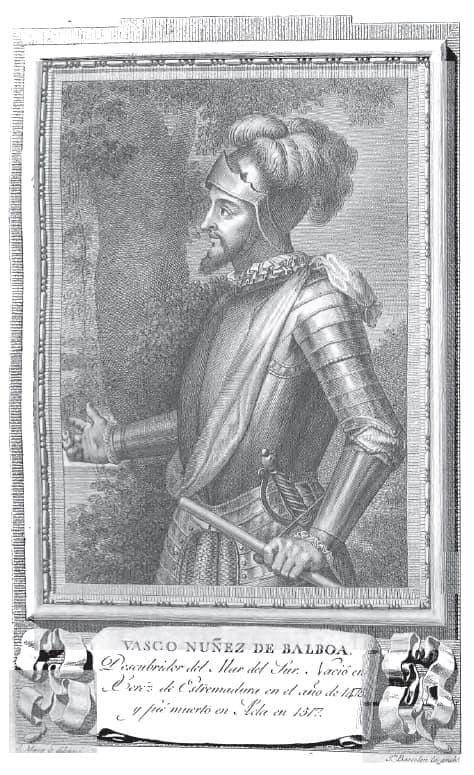
On September 25, 1513—though some accounts place the event on September 27—Spanish explorer and conquistador Vasco Núñez de Balboa climbed a peak in Darién on the Isthmus of Panama and became the first documented European to sight the Pacific Ocean from the Americas. His expedition had crossed a punishing landscape of dense rainforest, rivers, and swamps with the crucial assistance of Indigenous allies and porters, whose local knowledge helped guide the party through the isthmus.
From the mountaintop, Balboa saw the vast body of water he would call the Mar del Sur, or “South Sea.” A few days later, on September 29, he reached its shore and entered the water in a ceremonial act of possession, claiming the sea, its islands, and adjacent lands for the Spanish Crown.
Balboa’s Sighting was a major turning point in European exploration. It demonstrated that a great ocean lay beyond the American isthmus, reshaping Spanish ambitions and intensifying the search for a navigable westward route to the wealthy markets of Asia. The ocean later became known as the Pacific after Ferdinand Magellan’s voyage.
Yet Balboa’s triumph did not protect him from colonial politics. Pedro Arias Dávila—known as Pedrarias—came to regard Balboa as a dangerous rival. In 1519, Balboa was arrested, tried on charges including rebellion and treason, and beheaded at Acla along with several associates. Many historians view the trial as politically motivated, making his death an enduring example of the brutal rivalries of the Spanish conquest.
Image of Vasco Núñez de Balboa via Wikimedia Commons, public domain.
