
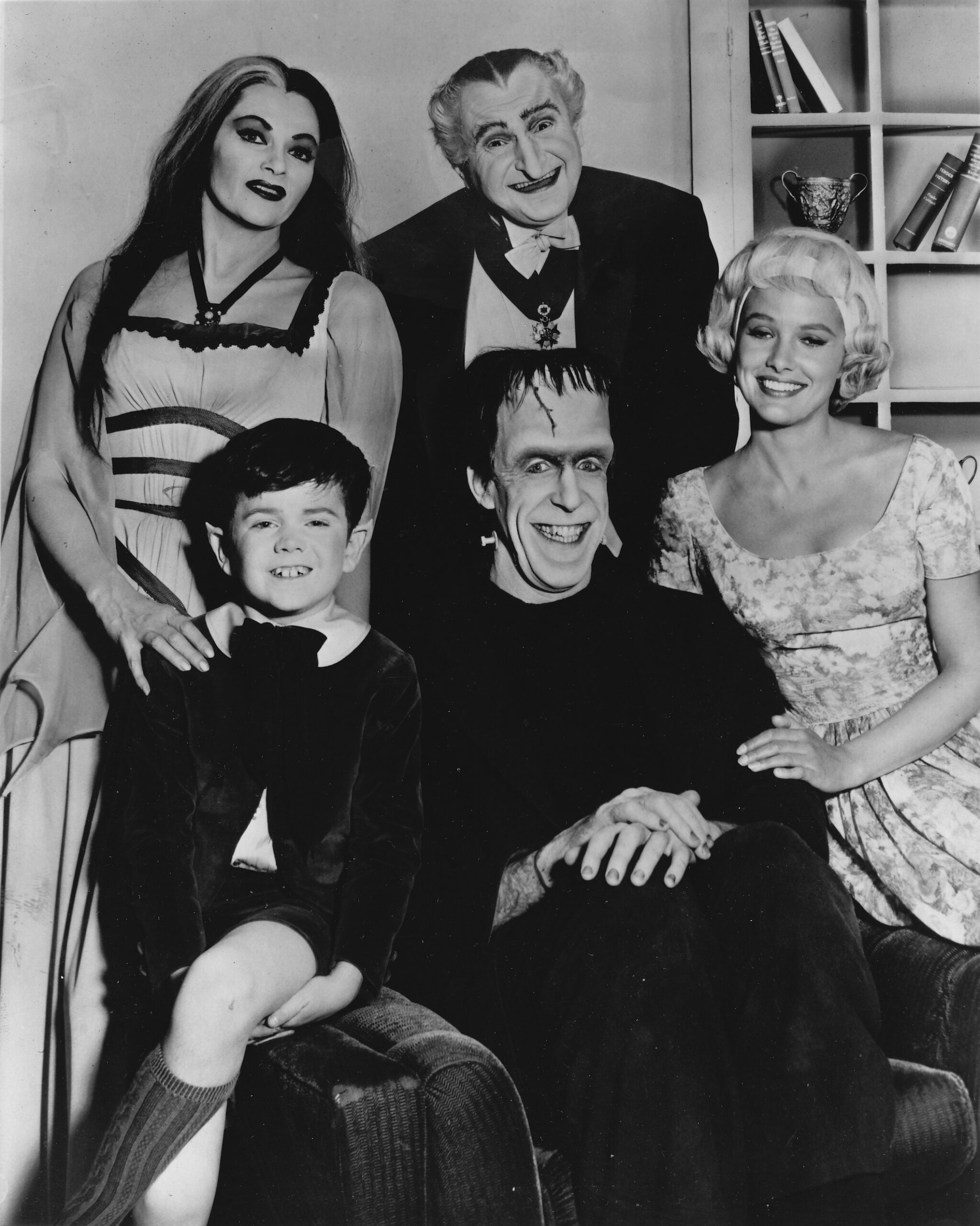
On September 24, 1964, The Munsters debuted on CBS, bringing a playful monster-movie twist to the familiar suburban family sitcom. Produced by Joe Connelly and Bob Mosher, the team behind Leave It to Beaver, the series imagined a household of good-natured ghouls trying to live an ordinary American life.
Its central family included Herman Munster, a Frankenstein’s-monster-like father; Lily, his vampire wife; Grandpa, her madcap vampire father; and their werewolf son, Eddie. The show’s lore drew directly on classic horror traditions: Herman’s backstory held that he had been assembled in a German laboratory in 1815 by Victor Frankenstein, and that he took the surname Munster after marrying Lily.
Much of the comedy came from the Munsters’ complete lack of self-consciousness. They regarded themselves as perfectly ordinary, while treating their conventionally attractive niece, Marilyn, as the family oddity. Through physical comedy, gothic sight gags, and gentle satire of mid-century domestic life, the series became a distinctive counterpart to television’s era of wholesome family sitcoms.
Fred Gwynne’s Herman, Yvonne De Carlo’s Lily, and Al Lewis’s Grandpa became its defining faces. The Munsters aired on CBS on Thursdays at 7:30 p.m. from September 24, 1964, through May 12, 1966, producing 70 episodes over two seasons.
The show made an early public splash that Thanksgiving, when Gwynne and Lewis appeared in full Munster makeup in the 1964 Macy’s Thanksgiving Day Parade. They rode through Manhattan in the custom Munster Koach, designed by noted car customizer George Barris; the vehicle went on to become one of the series’ most memorable visual symbols.
More than six decades later, The Munsters remains a fondly remembered example of television’s ability to combine old-Hollywood horror imagery with warm, offbeat family comedy.
Image via Wikimedia Commons, public domain.
