
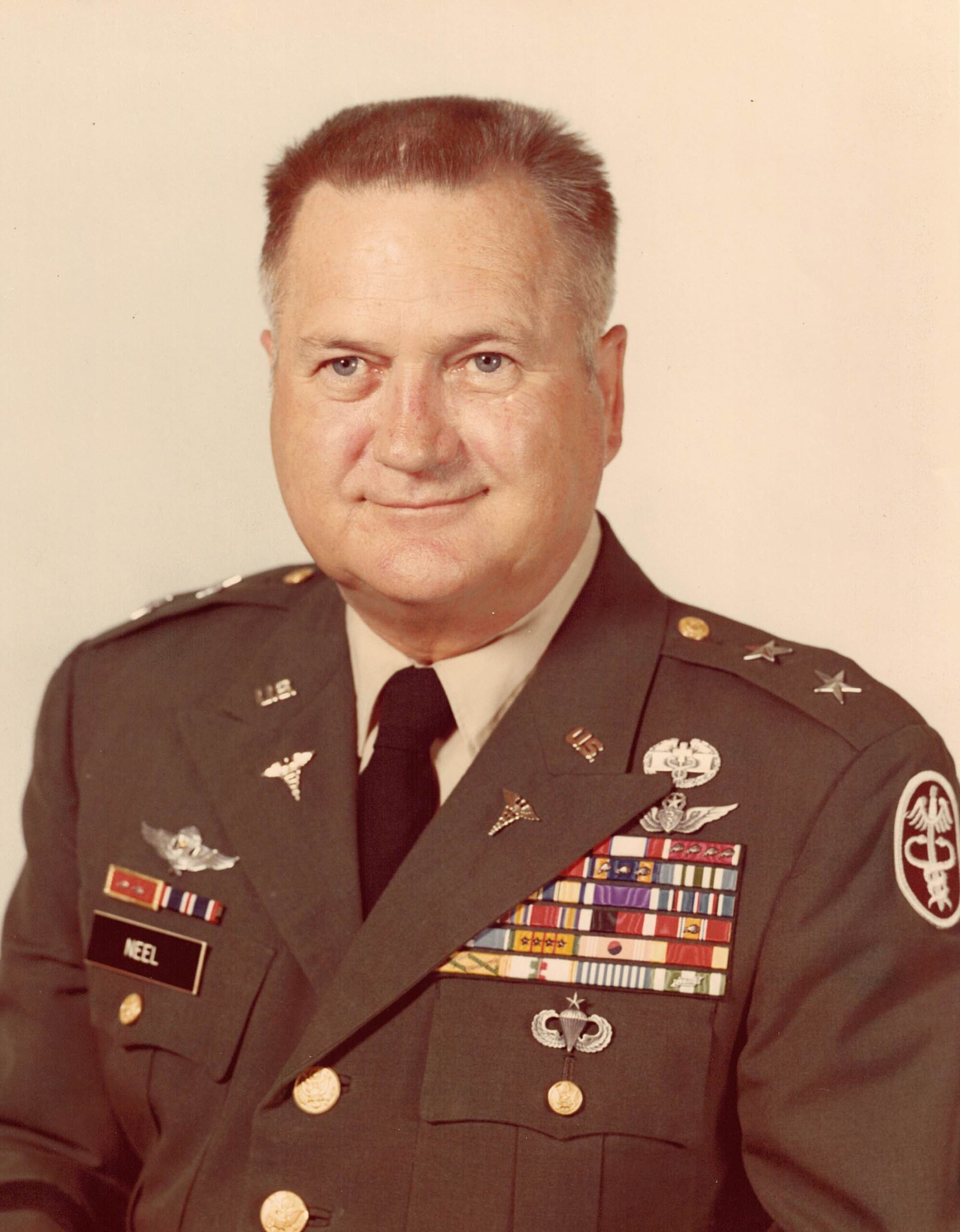
On September 24, 1919, Major General Spurgeon H. Neel Jr.—Army physician, military medical innovator, and leading architect of modern aeromedical evacuation—was born in Memphis, Tennessee.
After entering active duty in 1943 during World War II, Neel devoted a military career spanning more than three decades to advancing battlefield medicine. He recognized that survival often depended on one decisive factor: how quickly a wounded service member could move from the point of injury to definitive surgical care.
Drawing on experience in Korea and later Vietnam, Neel helped develop the policies, procedures, and organizations that made helicopter medical evacuation a reliable military capability. He advocated for medical control of evacuation, aircraft dedicated to the mission, and trained personnel able to provide care while moving casualties rapidly from combat zones to hospitals. His work helped establish the foundation for the Army’s modern aeromedical evacuation system and the helicopter missions widely known as “Dustoff.” The Army’s own historical account credits him, “as much as any other single factor,” with helping reduce mortality among wounded personnel in Korea.
Neel’s commitment was captured in a statement recalled by his wife: “My job is to take care of those boys. And I’m going to do it, and I want to be able to get them to the hospital as quickly as possible ….”
Beyond combat evacuation, Neel helped shape Army aviation medicine. In 1962, he and Major General Earnest Esterbrook established the U.S. Army Aeromedical Research Unit, a predecessor of today’s U.S. Army Aeromedical Research Laboratory. He also authored the Army’s official history Medical Support of the U.S. Army in Vietnam, 1965–1970.
Neel died in San Antonio on June 6, 2003, at age 83. Remembered as the “Father of Army Aviation Medicine” and a pioneer of battlefield aeromedical evacuation, his ideas helped establish practices that continue to influence both military casualty care and civilian helicopter emergency medical services.
