
In late August and early September 1664, control of New Amsterdam passed from the Dutch to the English. Four English warships under Colonel Richard Nicolls arrived in the harbor and demanded the surrender of New Netherland. Governor Peter Stuyvesant favored resistance, but many local residents and merchants opposed fighting: the colony lacked sufficient military supplies and reinforcements, and the English terms offered substantial protections. The resulting transfer occurred without a major battle.
The Articles of Capitulation protected much of the Dutch population’s existing position. Residents could retain their lands, houses, goods, and ships; Dutch settlers received liberty of conscience in religious worship; and Dutch inheritance customs were preserved. These provisions helped limit disruption during the change of government and allowed important elements of the colony’s multilingual, multiethnic, and commercially oriented society to continue under English rule.
The English renamed the colony New York in honor of James, Duke of York, brother of King Charles II and proprietor of the territory. The conquest brought the Hudson River region into England’s Atlantic empire and gave England control of a strategically important port between its New England and Chesapeake colonies. The Dutch briefly retook the city in 1673, renaming it New Orange, but English rule—and the name New York—was restored in 1674.
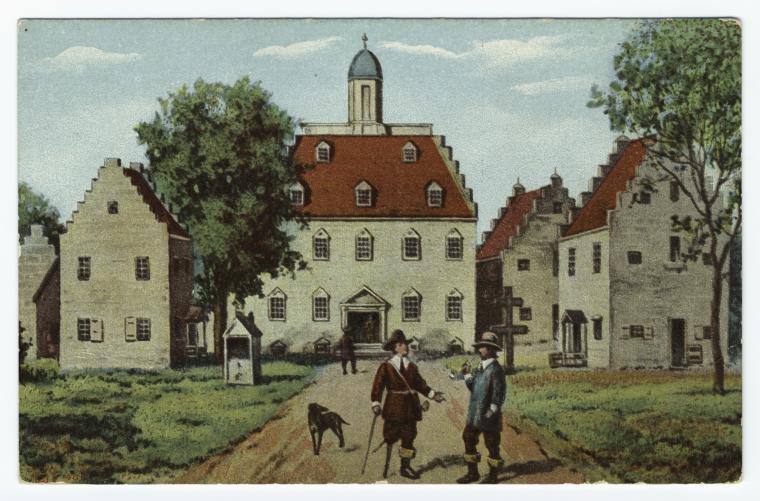
Image credit: Postcard depicting early New York City history, New York Public Library Digital Collections, public domain.
