
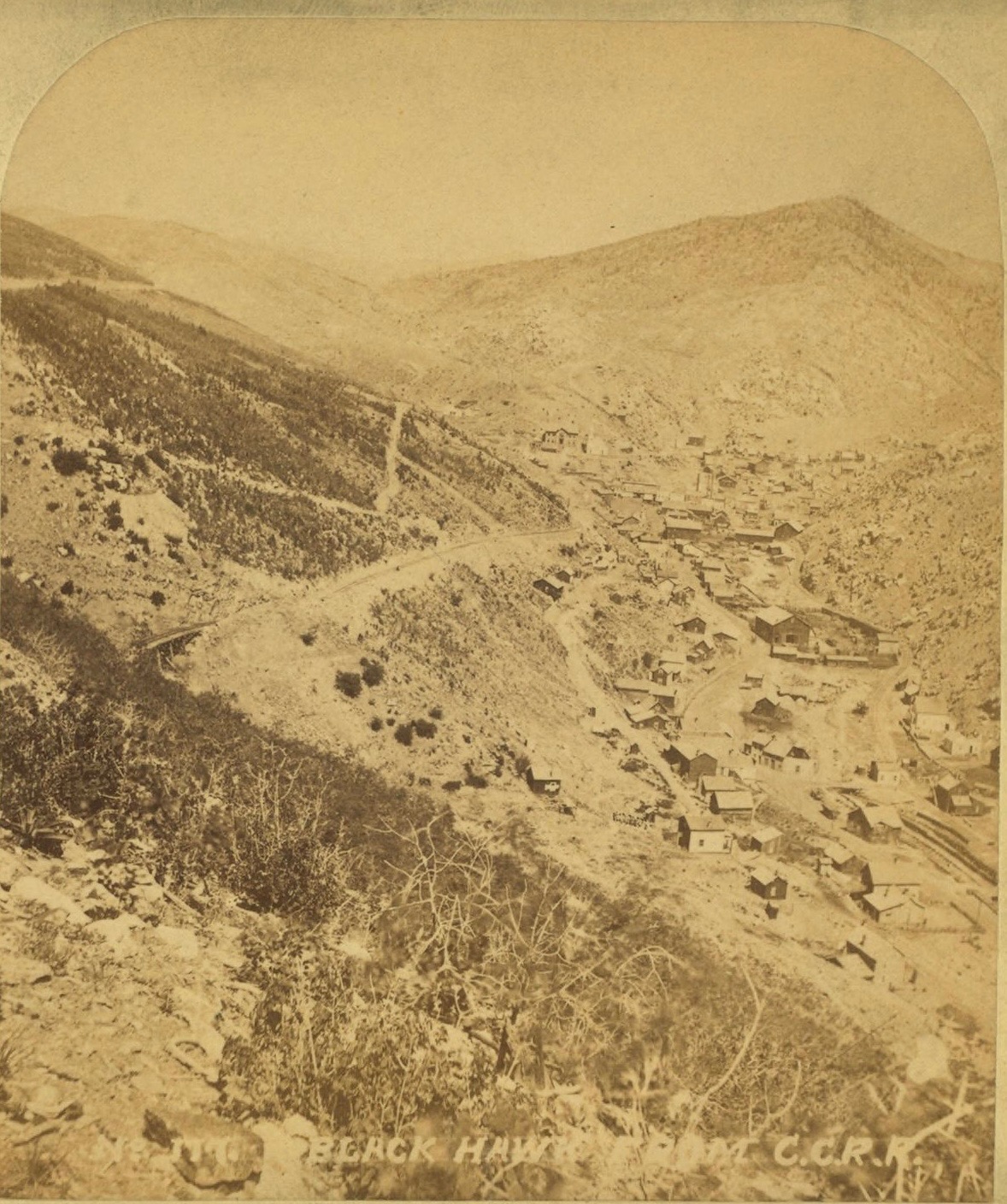
This late-nineteenth-century view looks west up Gregory Gulch in Black Hawk, Colorado, with Colorado Central Railroad tracks visible in the foreground. Set where Gregory Gulch meets North Clear Creek, Black Hawk developed as one of the principal settlements of the historic Gregory mining district, its buildings, mills, roads, and mine-related structures pressed into the narrow mountain valley.
Black Hawk was long associated with ore processing and was known as the “City of Mills.” Its access to water and comparatively level ground along the creek made it a natural location for stamp mills that treated ore from mines throughout Gilpin County [visitblackhawk]. The narrow-gauge railroad’s design was perfectly suited to the region’s steep grades and sharp mountain curves, facilitating the rapid transit of materials that traditional animal power could no longer sustain.
The arrival of the narrow-gauge Colorado Central Railroad at Black Hawk in December 1872 marked a major change for the district, reducing hauling costs and connecting the mining community more directly with Denver and wider rail markets, while local tram and rail links later helped move ore between nearby mining camps, mills, and railhead facilities. The line did not reach Central City until 1878, requiring the Gilpin County Tram-Railway to handle local traffic between the towns during the intervening years. Rather than presenting an untouched landscape, the photograph records a mountain corridor already reshaped by mining: rail infrastructure, mills, commercial buildings, and extraction works occupy the limited space between steep gulch walls, serving as a useful visual record of how Black Hawk became a transport and processing center during the later decades of Colorado’s nineteenth-century mining boom.
