
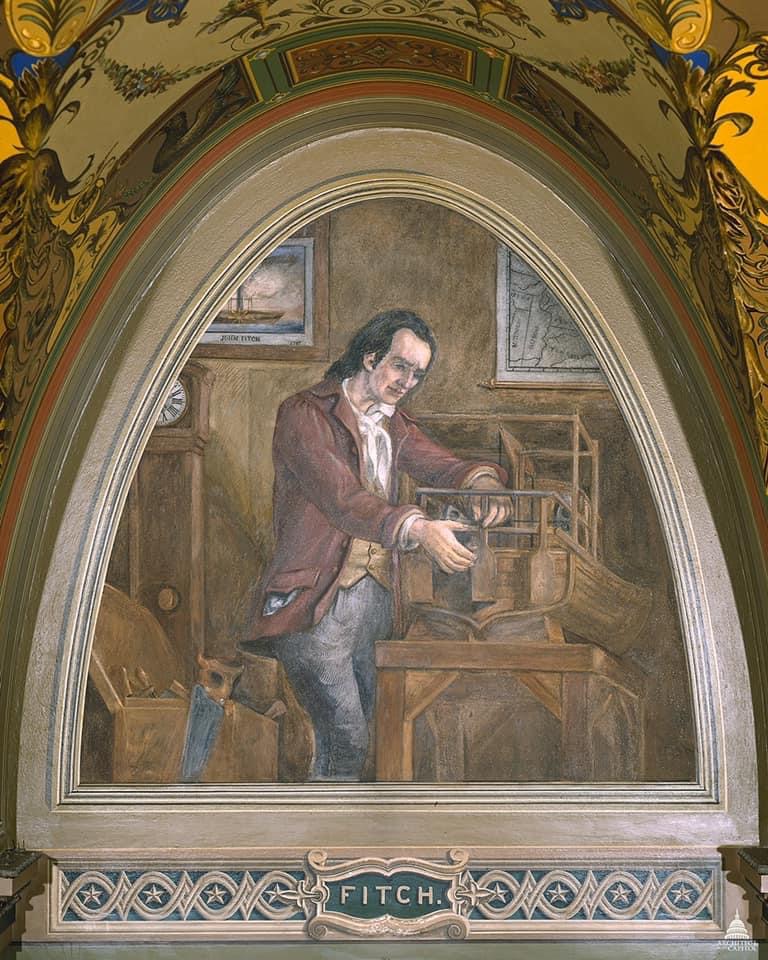
On August 26, 1791, American inventor John Fitch received a federal patent for his steamboat design, a milestone that marked the climax of the young nation’s first industrial patent war. For years, Fitch and his rival James Rumsey had fiercely contested the future of steam navigation, each lobbying the newly formed federal Patent Commission for exclusive control over the technology.
The commission — led by Secretary of State Thomas Jefferson — refused to grant Fitch the sweeping monopoly he sought. Instead, in a calculated effort to avoid choosing sides in a politically charged feud, the board issued overlapping design patents to Fitch, Rumsey, and two additional claimants on the very same day. Fitch’s mechanism used a Watt‑type engine to drive a bank of side‑mounted oars, while Rumsey’s competing system forced high‑pressure water through the stern in an early jet‑propulsion design.
The decision proved devastating for Fitch. Without an exclusive patent, his investors panicked and withdrew their support, leaving him unable to sustain regular passenger and freight operations despite the mechanical success of his vessels. He died in poverty, a casualty of the nation’s earliest attempt to balance innovation with fairness.
Yet his work endured. The engineering principles embedded in Fitch’s 1791 patent became foundational to the steamboat revolution that followed, providing the technical stepping stones later inventors would refine into commercial success. Today, his persistence is commemorated in Connecticut, where a major boulevard bears his name — a lasting reminder of the first great American battle over steam.
Image via Wikimedia Commons, public domain.
