
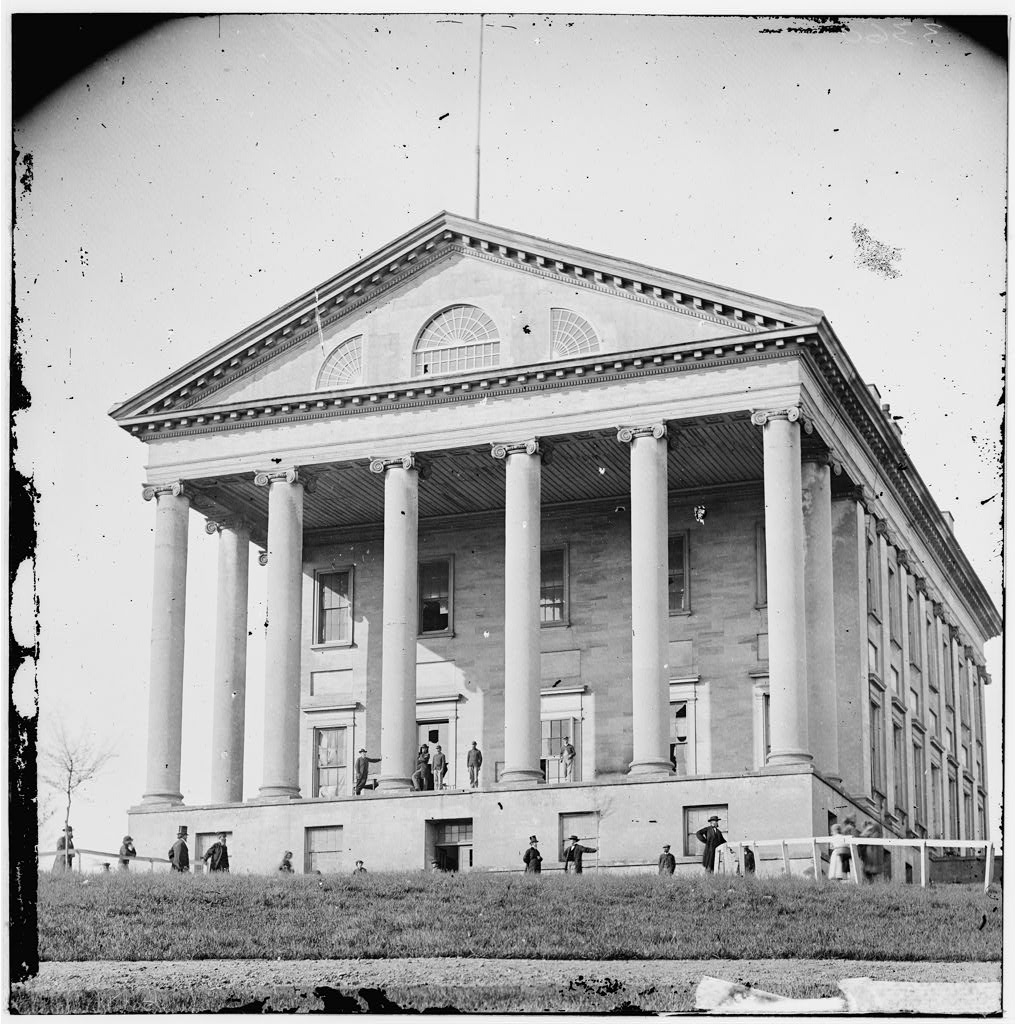
On June 25, 1788, Virginia became the tenth state to ratify the United States Constitution—a narrow, hard‑won decision that effectively secured the political future of the fragile young republic. Inside the newly built Temporary Academy on Richmond’s Shockoe Hill, delegates battled through blistering heat and blistering rhetoric. Federalists like James Madison argued that only a stronger national framework could preserve liberty, while Anti‑Federalists led by Patrick Henry warned that centralized power would swallow both individual rights and state sovereignty. When the votes were finally cast, the Constitution survived by the razor‑thin margin of 89–79.
Though the decisive vote occurred at the academy, the moment’s architectural legacy belongs to Thomas Jefferson’s newly completed Virginia State Capitol. Modeled on a Roman temple and captured here in a stark 19th‑century photograph before its modern wings were added, the Capitol became the enduring symbol of the commonwealth’s authority. Its clean, classical silhouette stands as a physical testament to the institutional permanence forged on that sweltering June afternoon—when Virginia’s choice tipped the balance toward a unified nation.
