
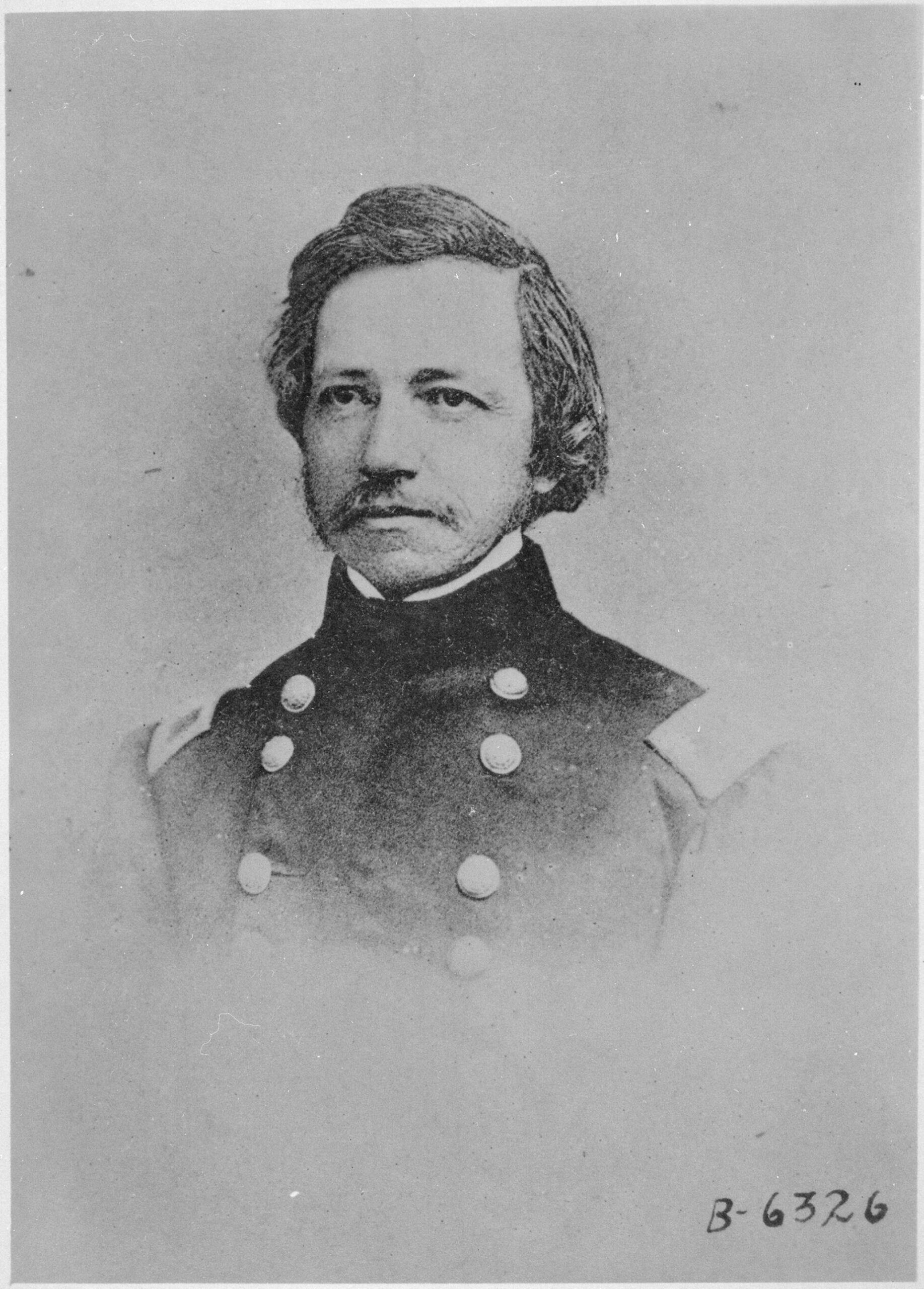
On October 5, 1853, Lt. Amiel Weeks Whipple’s U.S. Army survey party reached Albuquerque in New Mexico Territory during its westward journey from Fort Smith, Arkansas. Whipple, an officer of the Corps of Topographical Engineers, had been assigned to examine a potential Pacific railroad route roughly along the 35th parallel as part of the federally authorized Pacific Railroad Surveys.
The party, numbering about 70 soldiers, teamsters, and scientific personnel, had left Fort Smith in July and crossed Indian Territory, the Texas Panhandle, and northern New Mexico. Albuquerque served as an important supply and staging point: the party obtained a military escort there, and the experienced western guide Antoine Leroux joined the expedition before its passage through the difficult country farther west.
Whipple’s survey documented terrain, water sources, routes, natural history, and communities along a possible railroad corridor. It concluded that a railroad route along the 35th parallel was feasible, although the journey revealed substantial obstacles in the Southwest’s arid terrain and river crossings.
The expedition continued through present-day Arizona, crossed the Colorado River near the Needles on February 27, 1854, and reached Los Angeles on March 20. Its reports became an important body of scientific and geographic information, and portions of the route later informed railroad construction, notably the Atchison, Topeka and Santa Fe’s southwestern corridor.
Less than a decade after completing this landmark survey, Whipple’s engineering skill and command ability were called upon in service of the Union during the American Civil War.
Early in the conflict, Whipple prepared important maps of the northern Virginia theater and briefly supervised the Army’s nascent balloon-reconnaissance operations under General Irvin McDowell. Promoted to brigadier general of volunteers in 1862, he later commanded a division in the III Corps and led troops at the Battle of Fredericksburg. On May 4, 1863, while overseeing the construction of defensive earthworks during the Battle of Chancellorsville, Whipple was mortally wounded by a Confederate sharpshooter. He died three days later in Washington, D.C.; that day, President Abraham Lincoln—an acquaintance of Whipple’s—signed his posthumous promotion to major general.
