
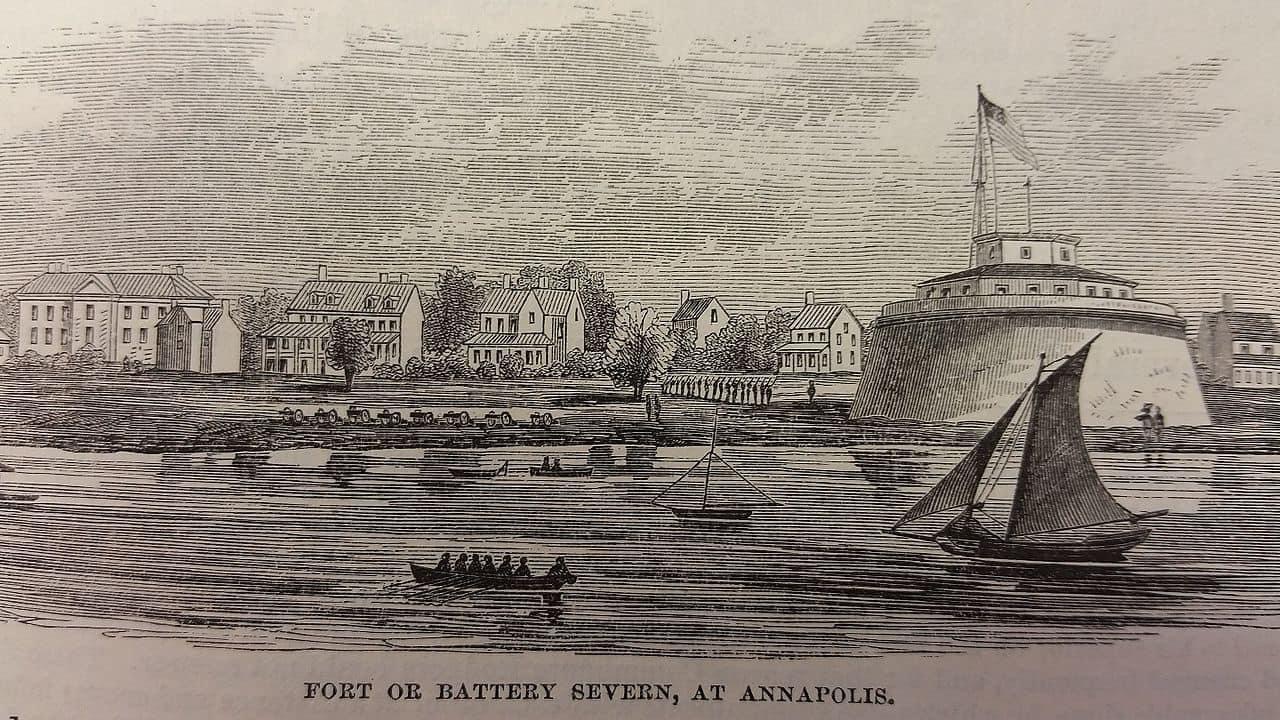
On October 10, 1845, the United States Naval Academy formally opened in Annapolis, Maryland, under its original name, the Naval School. Secretary of the Navy George Bancroft established the school at Fort Severn, a former Army post, with an initial class of about fifty midshipmen and a faculty of seven professors. Its founding created a permanent, centralized system for educating naval officers, moving the Navy away from reliance chiefly on informal, shipboard apprenticeship.
One major catalyst was the 1842 Somers affair. After an alleged mutiny plot aboard the training brig USS Somers, three crewmen—including Midshipman Philip Spencer, the son of Secretary of War John C. Spencer—were executed at sea. The episode intensified doubts about the practice of sending young midshipmen directly aboard ship to learn through experience alone and added momentum to calls for formal naval education. Under its first superintendent, Commander Franklin Buchanan, the new school taught mathematics, navigation, gunnery, steam engineering, chemistry, English, natural philosophy, and French.
In 1850, the Naval School was redesignated the United States Naval Academy. A consecutive four-year curriculum, supplemented by summer practice cruises, followed in 1851. Over the next century, the campus grew from a small former Army post into a leading military institution, educating figures such as Fleet Admiral Chester W. Nimitz, President Jimmy Carter, and astronaut Alan Shepard. The school’s opening on this day helped professionalize the American naval officer corps by making scientific education, technical expertise, and disciplined leadership central to naval command.
