
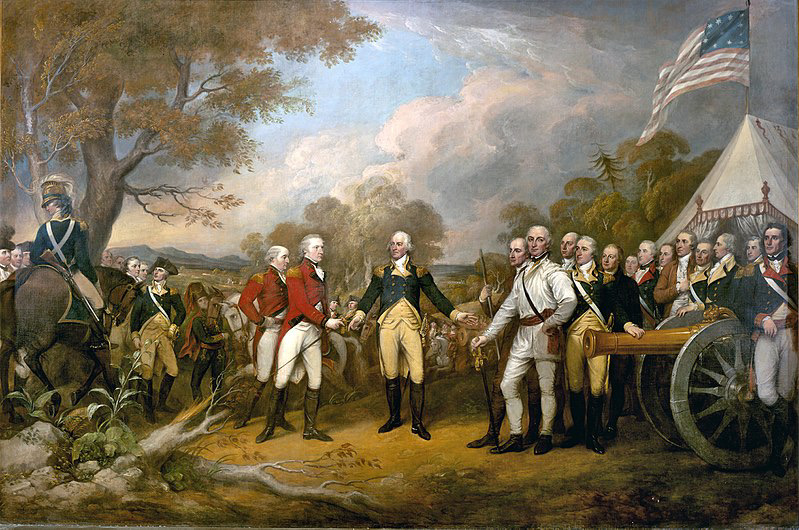
On October 17, 1777, the American struggle for independence gained a decisive victory when British General John Burgoyne surrendered his army to American General Horatio Gates following the Battles of Saratoga. In his painting Surrender of General Burgoyne, John Trumbull portrays the British commander offering his sword to Gates, who declines it and instead offers hospitality—a gesture of respect toward his defeated opponent.
The surrender marked the collapse of a British campaign intended to isolate New England from the other colonies by controlling the Hudson River corridor. Burgoyne’s army, which included British regulars, German troops, Loyalists, and Native American allies, had advanced south from Canada but failed to reach its objective. After two battles and a retreat, the exhausted army found itself surrounded by a growing American force and compelled to surrender.
The consequences reached far beyond the battlefield. News of Saratoga helped persuade the French monarchy to commit to a formal alliance with the United States, signed on February 6, 1778. France had already provided covert aid; the alliance brought that support into the open, followed by French troops and naval forces that proved critical to American independence. Saratoga did not end the war, but it helped transform the struggle into an international conflict and gave the American cause a powerful new ally.
Image: John Trumbull, Surrender of General Burgoyne (1821), via Wikimedia Commons. Public domain in the United States.
