
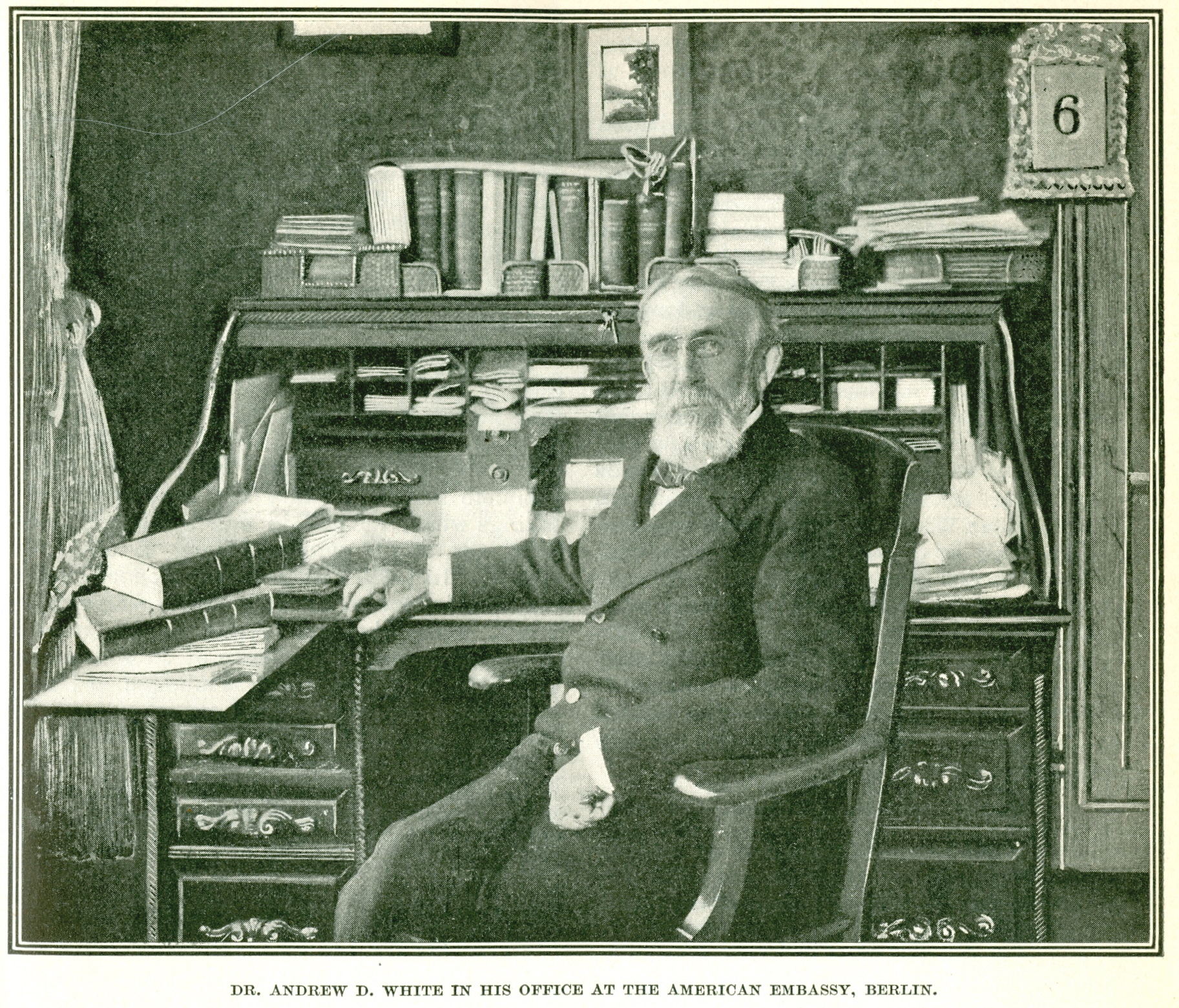
Born on November 7, 1832, in Homer, New York, Andrew Dickson White became an influential educator, historian, and diplomat. After graduating from Yale in 1853, he spent three years studying and traveling in Europe, experiences that helped shape his vision for American higher education. As a New York state senator, he joined Ezra Cornell in founding Cornell University, chartered in 1865. Elected its first president in 1866, White helped turn their shared ambitions into a working institution, recruiting faculty and developing its library and teaching collections.
Cornell’s innovation was not the abandonment of classical learning but its integration with a much broader range of studies. Greek, Latin, and literature stood alongside agriculture, engineering, modern history, and the natural sciences. Ezra Cornell’s promise of an institution where “any person can find instruction in any study” expressed the breadth of this undertaking. White helped give that vision institutional form, supporting an education that combined practical training with liberal learning.
A devoted book collector, White also regarded a great library as essential to a great university. In 1885, he offered Cornell his personal collection of approximately 30,000 books, substantially enriching the library he had already helped build. His family life also connected him with a pioneering scholar: Helen Magill, whom he married in 1890, had become the first woman to earn a Ph.D. in the United States when she completed her doctorate in Greek at Boston University in 1877.
White’s career extended beyond Cornell. As the first president of the American Historical Association, he participated in the development of history as an organized academic profession. He also served as United States minister to Germany from 1879 to 1881, minister to Russia from 1892 to 1894, and ambassador to Germany from 1897 to 1902. In 1899, he headed the American delegation to the Hague Peace Conference. His career linked university building, historical scholarship, and diplomacy, illustrating the varied public roles available to a leading American scholar of his generation.
