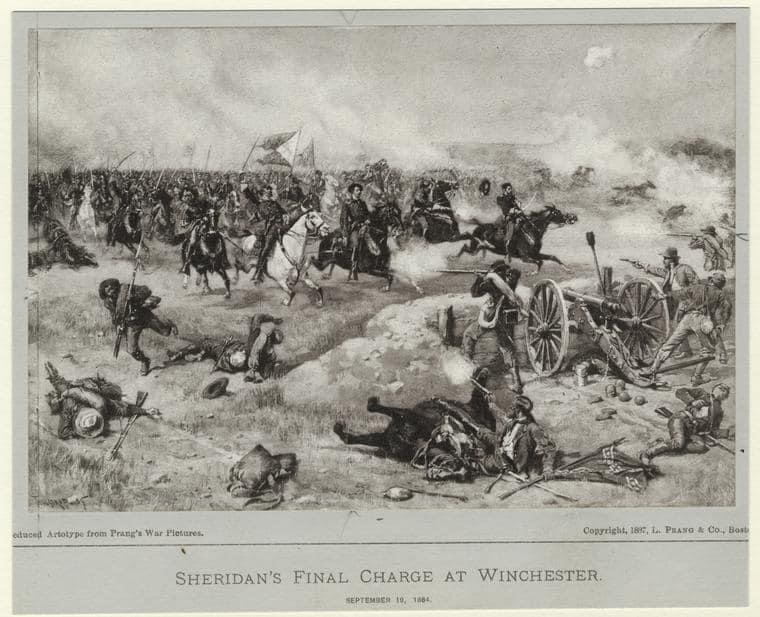
On September 19, 1864, the Shenandoah Valley erupted in cannon fire and musketry as Union troops advanced on Confederate positions east of Winchester, Virginia. Commanded by Major General Philip Sheridan, the attack was part of a broader Union effort to drive Lieutenant General Jubal A. Early’s Confederate army from the strategically vital Shenandoah Valley and deny the Confederacy its agricultural resources and avenue of invasion.
The battle—also known as the Battle of Opequon—became the largest and bloodiest engagement ever fought in the Shenandoah Valley. Sheridan’s VI and XIX Corps advanced from the east along the Berryville Pike, but difficult ground and determined Confederate resistance delayed the Union attack and gave Early time to concentrate his outnumbered forces. Throughout the day, veteran infantry formations fought fiercely across fields, woods, and earthworks outside Winchester.
By late afternoon, Sheridan committed Major General George Crook’s VIII Corps and Union cavalry against the Confederate left. The coordinated assault broke Early’s line near the northern approaches to the town, including the defenses around Fort Collier. Early ordered a general retreat, and Confederate troops withdrew through Winchester toward Fisher’s Hill, roughly twenty miles to the south.
The Union victory was costly: approximately 54,400 soldiers took part, and the combined casualty total was about 8,630. Sheridan lost roughly 5,020 men, while Early’s army suffered about 3,610 casualties—a particularly severe loss given the Confederates’ much smaller force.
Image: Sheridan’s final charge at Winchester, September 19, 1864 via NYPL Digital Collections, no known restrictions