
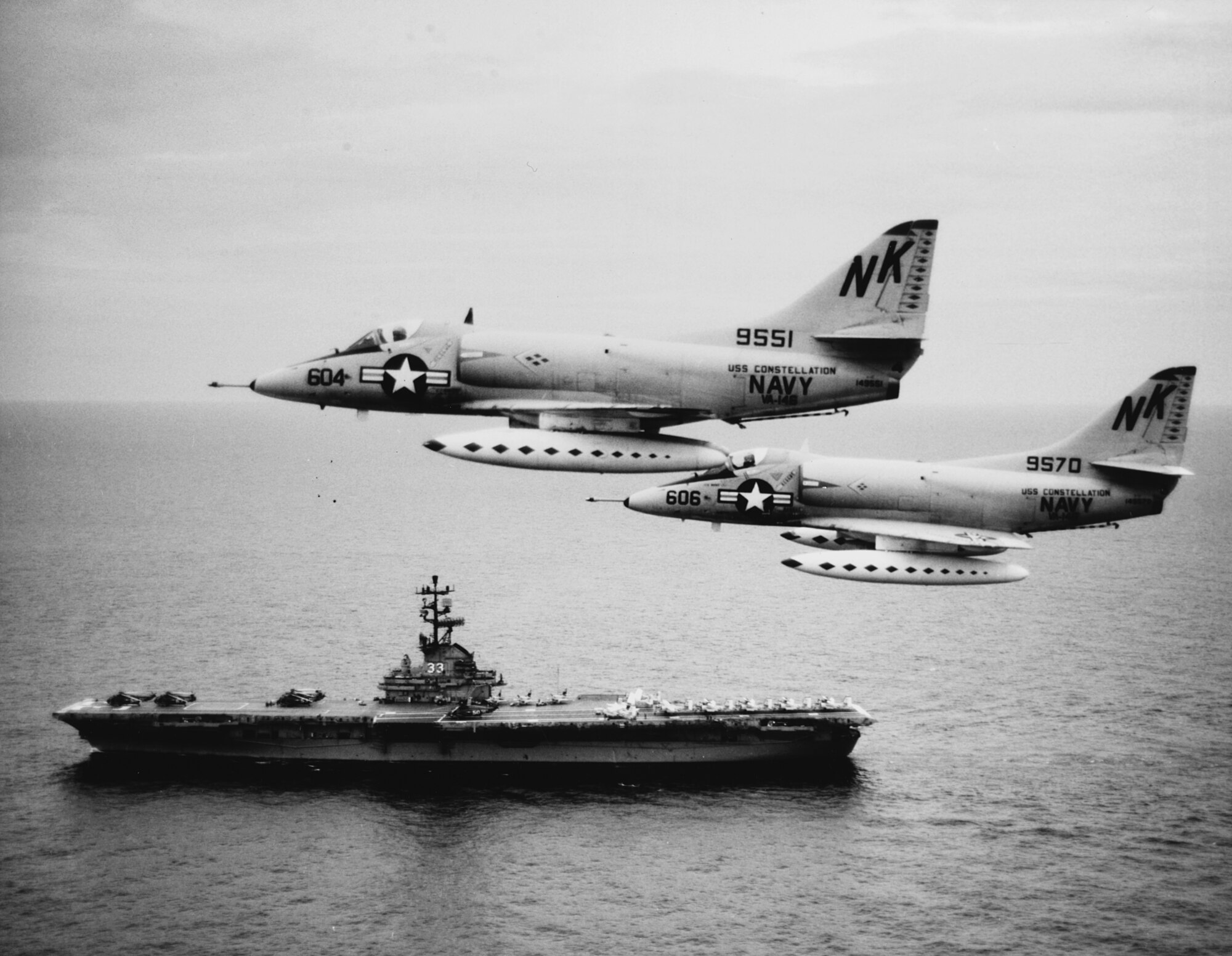
On August 12, 1964, the humid air over the South China Sea vibrated with the rising tension of a world inching toward deeper conflict. Just days after the Gulf of Tonkin incident jolted the United States into a new military posture, the USS Kearsarge (CVS‑33) found itself thrust into a rapidly shifting strategic landscape. Originally built during the twilight of World War II and later refitted as an anti‑submarine warfare carrier, the Kearsarge was suddenly required to project far more than quiet vigilance. She now had to demonstrate unmistakable American resolve.
That morning, A‑4C Skyhawks of Attack Squadron 146 — sleek, nimble jets affectionately nicknamed “Heinemann’s Hot Rods” — roared off her deck and carved disciplined arcs across the sky. These flights were not tied to a single dramatic engagement; rather, they formed part of a relentless series of reconnaissance sweeps, deterrent passes, and high‑visibility patrols that defined the carrier’s intensified operational tempo in the days following Tonkin. Each low, controlled thunder of the Skyhawks past the Kearsarge’s superstructure served as a visible reminder to both allies and adversaries that the United States commanded the surrounding airspace with absolute confidence.
For the pilots strapped into those compact cockpits, the missions carried a razor‑thin margin between routine patrol and sudden escalation. They skimmed the surface of treacherous waters, scanning for signs of North Vietnamese or Soviet activity, fully aware that the geopolitical fuse had already been lit. Within months, these seemingly ordinary flights would evolve into sustained bombing campaigns and high‑risk combat sorties, transforming the Skyhawk from a symbol of deterrence into one of the most recognizable aircraft of the Vietnam War.
The Skyhawks that flew on August 12 did not fire a shot, but their presence marked a pivotal moment — the quiet prologue to a conflict that would define an era. Their disciplined formation over the South China Sea captured the exact instant when Cold War tension hardened into a long, grinding struggle that reshaped American military history.
