
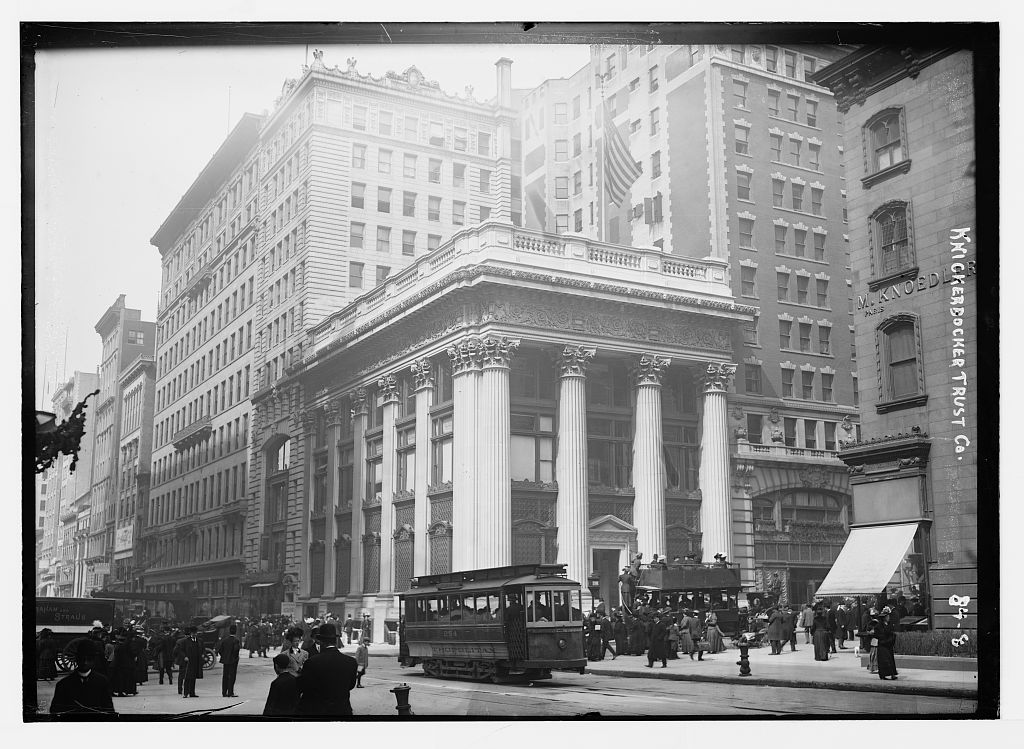
On October 22, 1907, New York City’s Knickerbocker Trust Company suspended operations after a devastating bank run, marking a decisive escalation of the Panic of 1907. The city’s third-largest trust company paid out roughly $8 million in just three hours before halting payments shortly after noon. Confidence collapsed following a failed attempt to corner shares of the United Copper Company—not the global copper market—and revelations of Knickerbocker president Charles T. Barney’s ties to financier Charles W. Morse. On October 21, Knickerbocker’s directors removed Barney, and the National Bank of Commerce announced it would no longer clear checks for the trust. These developments triggered immediate panic among depositors, although Barney’s associations do not themselves prove that he used Knickerbocker’s funds to finance the failed speculation.
Knickerbocker’s suspension spread alarm to neighboring institutions, particularly the Trust Company of America, while a severe scramble for cash disrupted lending and paralyzed stock-market financing. J. P. Morgan declined to rescue Knickerbocker after a rapid examination failed to establish its solvency, but he subsequently helped coordinate emergency support for other institutions and the financial markets. These efforts unfolded over several grueling days. The famous meeting at which Morgan reportedly locked financiers inside his library until they reached an agreement occurred on the night of November 2–3, not in the immediate aftermath of the October 22 run. Notably, Knickerbocker’s closure was temporary; it reopened in March 1908 after securing $2.4 million in new capital.
The crisis exposed systemic vulnerabilities in America’s banking system, particularly the lack of a central bank, uneven access to emergency assistance, and trust companies’ vulnerability to runs because they held smaller cash reserves relative to deposits than national banks. The system was not entirely unregulated, but its existing safeguards proved inadequate to contain the panic without improvised private intervention. The broader Panic of 1907 became a major impetus for monetary reform, ultimately culminating in the creation of the Federal Reserve System in 1913. Knickerbocker’s suspension was a defining catalyst in that history, rather than its sole cause. Its enduring significance lies in demonstrating how a sudden loss of confidence at a single major institution could spread across the financial system, threatening credit and economic stability nationwide.
