
On September 12, 1918, the American Expeditionary Forces launched the Saint-Mihiel Offensive in northeastern France, the first major U.S.-led offensive of World War I. General John J. Pershing commanded the operation with the newly organized U.S. First Army, reinforcing his determination to employ American troops as a unified force rather than disperse them among French and British commands.
The offensive targeted the Saint-Mihiel salient, a heavily defended, horseshoe-shaped bulge in the German line that had disrupted Allied rail connections in the region since 1914. Nearly half a million American soldiers, supported by four French divisions under U.S. command, attacked from multiple directions after an extensive artillery bombardment. The operation also featured a large Allied air force coordinated in part by Colonel William “Billy” Mitchell and tank units associated with George S. Patton.
The attack succeeded rapidly in part because German forces had already begun withdrawing from the salient. American troops encountered uneven and increasingly disorganized resistance, closed the salient in roughly 36 hours, and captured thousands of prisoners and hundreds of artillery pieces. Sporadic fighting continued until September 16, when the offensive officially ended.
Saint-Mihiel was an important operational and symbolic victory for the United States. It demonstrated that the American First Army could coordinate a large-scale combined-arms offensive and restored an important rail route for Allied use. Just as importantly, it gave the AEF experience and momentum before the much larger Meuse-Argonne Offensive later that month.
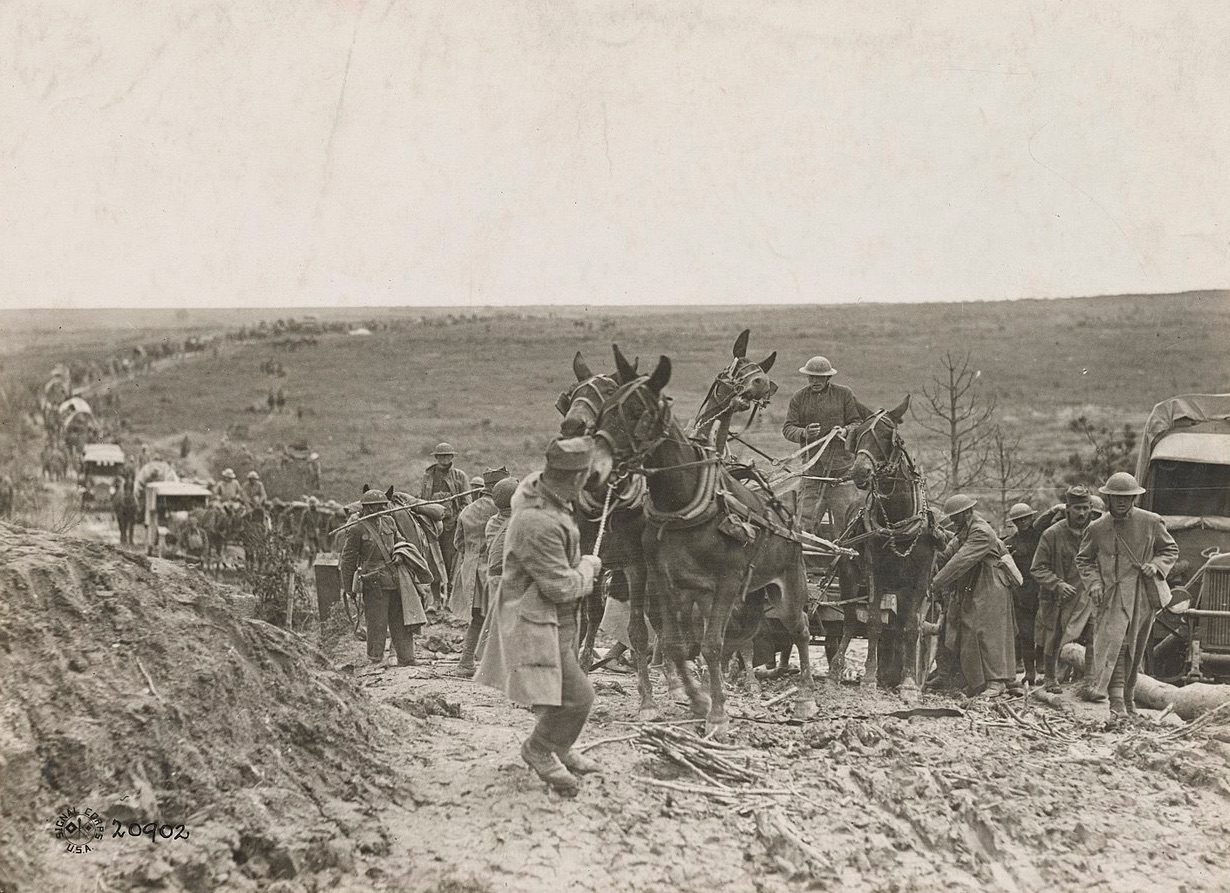
Image: American forces move along a muddy road near Saint-Mihiel, via Wikimedia Commons, public domain.
