
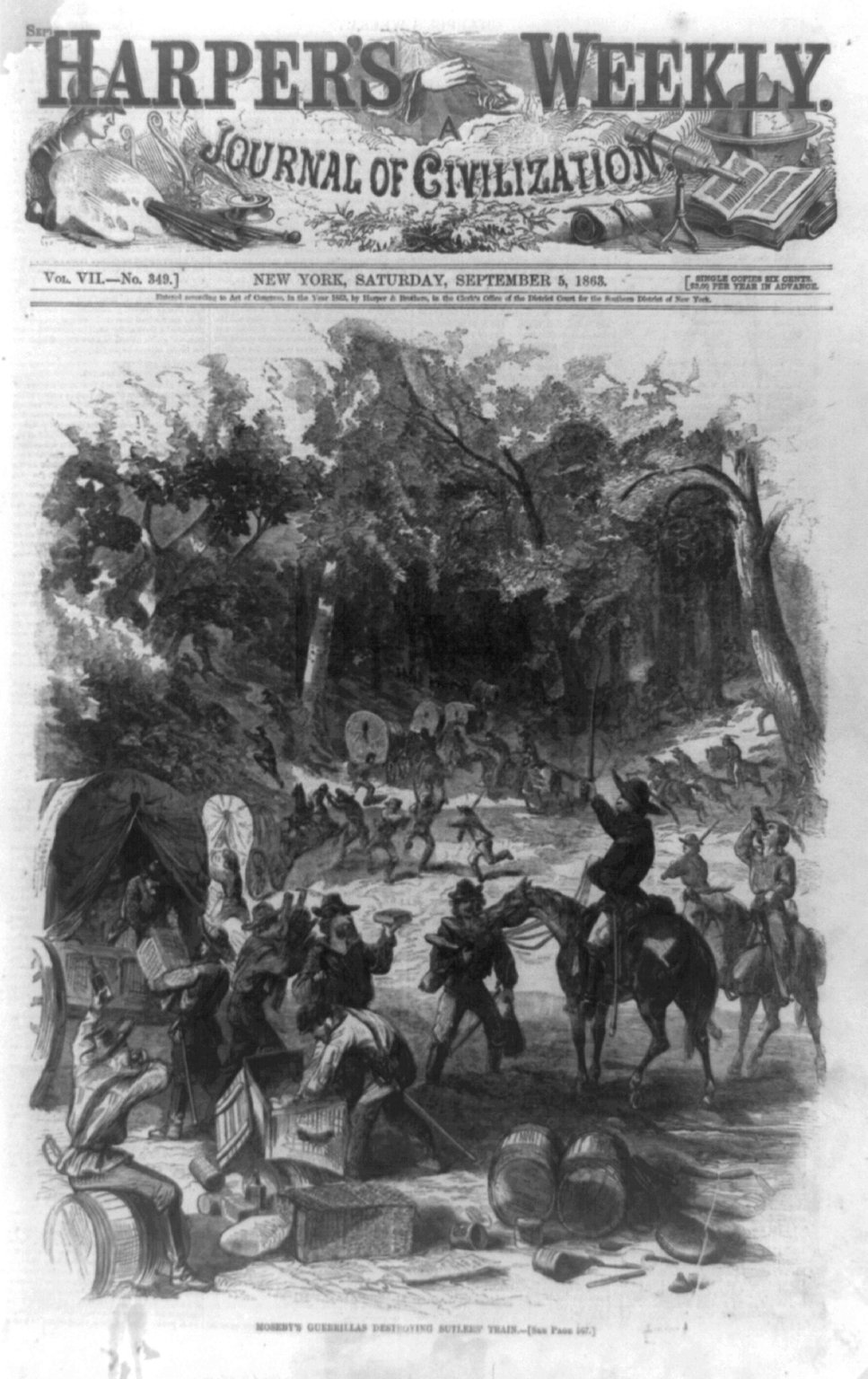
On September 5, 1863, Harper’s Weekly published a dramatic front-page wood engraving titled “Mosby’s Guerrillas Destroying Sutlers’ Train.” The image showed Confederate partisan rangers associated with Col. John S. Mosby overrunning a Union sutler’s wagon train, transforming a routine supply operation into a scene of mounted raiding, plunder, and disorder. The Library of Congress identifies the illustration as a 1863 Harper’s Weekly title page depicting “Mosby’s guerrillas destroying sutlers’ train.”
Sutlers were privately licensed merchants who accompanied armies and sold soldiers items beyond official issue—such as food, tobacco, clothing, and small personal comforts. Their wagons could carry cash and commercially valuable goods as well as supplies, making them attractive targets for mobile raiding parties. The attack represented the kind of vulnerability that partisan warfare exploited: slow-moving transport, lightly protected rear areas, and an enemy dependent on extended lines of movement and supply.
The engraving is therefore more than an illustration of a raid. It is a material record of guerrilla warfare’s effects on the Union war effort in Virginia. By centering wagons, goods, animals, and civilian merchants operating alongside the army, it reveals how irregular warfare could make the infrastructure behind conventional armies a contested battlefield. Mosby’s men did not need to defeat a major Union formation in open battle to impose costs; raids on vulnerable transport could disrupt movement, consume guard resources, and contribute to the persistent insecurity of Union-held territory.
Image via Wikimedia Commons, public domain
