
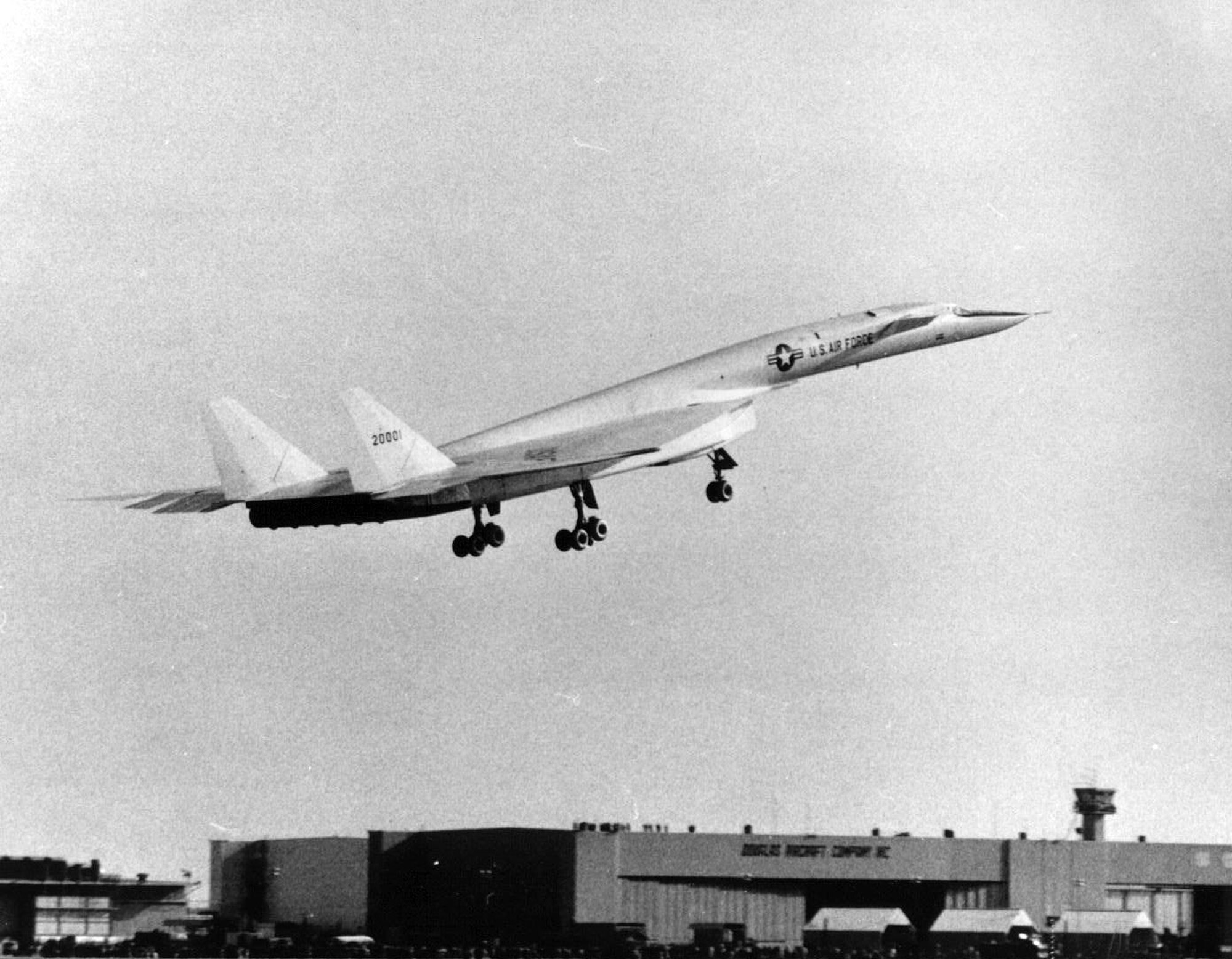
On September 21, 1964, the North American Aviation XB-70 Valkyrie made its first flight, traveling from Air Force Plant 42 in Palmdale, California, to Edwards Air Force Base. Flown by North American chief test pilot Alvin S. White and U.S. Air Force Col. Joseph F. Cotton, the short inaugural sortie introduced one of the most audacious aircraft designs of the Cold War.
The Valkyrie had originated in the late 1950s as a proposed high-altitude, Mach 3 strategic bomber for Strategic Air Command. The production B-70 concept was intended to penetrate Soviet airspace at extreme speed and altitude, flying at around 70,000 feet, where its speed and height were expected to complicate interception. By the time the XB-70 flew, however, the strategic environment had changed: increasingly capable surface-to-air missiles and the growing centrality of intercontinental ballistic missiles had weakened the case for deploying a large manned Mach 3 bomber.
Its engineering was extraordinary. Designed for the intense aerodynamic heating of sustained high-speed flight, the aircraft used brazed stainless-steel honeycomb structure alongside titanium components. Its huge outer wing panels could hinge downward at supersonic speeds, a distinctive feature that reduced drag associated with the inlet shock system and improved directional stability at high Mach numbers.
Only two XB-70A prototypes were completed, and neither became an operational bomber. Yet the Valkyrie’s flight-test program produced valuable high-speed aerodynamics, structures, propulsion, and handling data, including information relevant to the era’s proposed supersonic transports. The maiden-flight photograph endures because it captures not a deployed weapon system, but the emergence of a remarkable experimental aircraft—an icon of the ambition, technical ingenuity, and strategic uncertainty of the Cold War aerospace race.
Photograph of the USAF’s XB-70 Valkyrie during its maiden flight on September 21, 1964. Image via Wikimedia Commons; public domain in the United States.
