
On September 21, 1942, Boeing’s first XB-29 Superfortress prototype made its maiden flight from Boeing Field in Seattle, Washington. Commanded by Boeing flight-test leader Edmund T. “Eddie” Allen, with Al Reed serving as copilot, the four-engine bomber completed a successful 75-minute initial test flight—an essential milestone in the development of one of World War II’s most technologically advanced aircraft.
Developed to meet the U.S. Army Air Forces’ requirement for a very-long-range strategic bomber, the B-29 introduced major advances including pressurized crew compartments, tricycle landing gear, and a centralized fire-control system that operated remotely controlled defensive gun turrets. Its four Wright R-3350 Duplex-Cyclone radial engines were designed to give it the speed, altitude, range, and bomb capacity needed for operations across the vast Pacific theater.
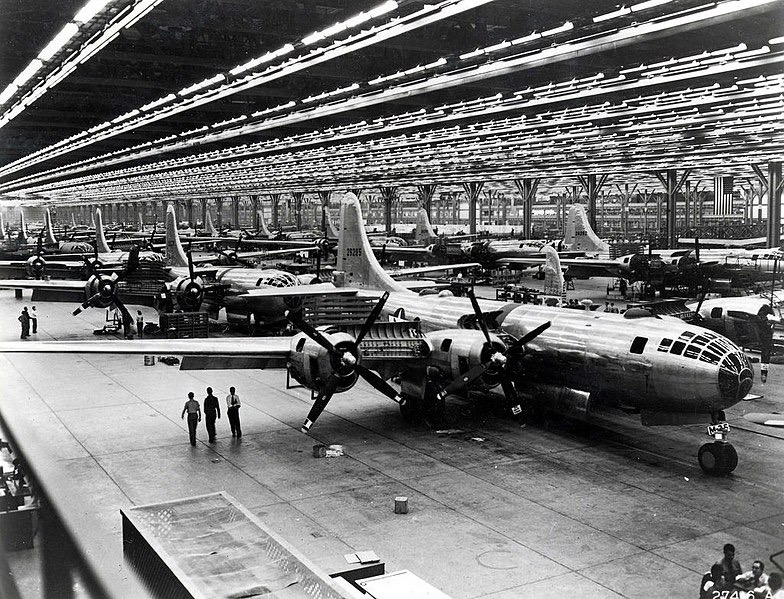
The B-29 program required an enormous wartime industrial and training effort, with Boeing’s Wichita, Kansas, plant becoming a central production site. The aircraft first flew combat missions on June 5, 1944, against targets near Bangkok, Thailand; B-29 raids against Japan followed later that month, while sustained bombing operations from the Mariana Islands began in late 1944.
The prototype of the B-29 bomber made its first flight at Boeing Field, Seattle on September 21, 1942. It would be two years before B-29’s were flying combat missions. Shown here is Boeing’s Wichita assembly plant in 1944. Image via USAFHRA via Wikimedia Commons, public domain in the US