
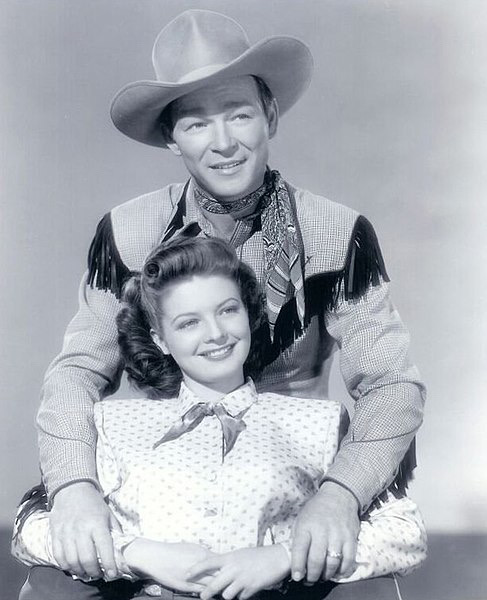
Born Leonard Franklin Slye on November 5, 1911, in Cincinnati, Ohio, Roy Rogers became one of the defining singing cowboys of American popular culture. His breakthrough came in 1938 with Under Western Stars, when Republic Pictures cast him during a contract dispute with its established Western star, Gene Autry. Rogers developed his own following through a combination of music, riding, and a dependable good-guy persona, appearing in 87 musical Westerns for Republic.
His popularity extended well beyond movie theaters. With his palomino horse, Trigger, and his wife and frequent collaborator, Dale Evans, Rogers carried his Western persona into radio, television, recordings, and merchandise. The Roy Rogers Show, which aired on television from 1951 to 1957, brought that familiar world into American homes. His three Hollywood Walk of Fame stars—for motion pictures, radio, and television—reflect the breadth of a career that crossed several major entertainment media.
Rogers’s lasting cultural significance lies partly in the version of the West he represented. His screen hero offered audiences a reassuring moral world in which honesty, courage, and loyalty prevailed. That persona was not a realistic account of frontier history; it was an entertainment ideal, sustained through songs, action, and familiar characters. His career illustrates how the cowboy became both a moral example and a marketable figure—and how that image could remain recognizable as entertainment moved from the movie theater to the television screen.
