
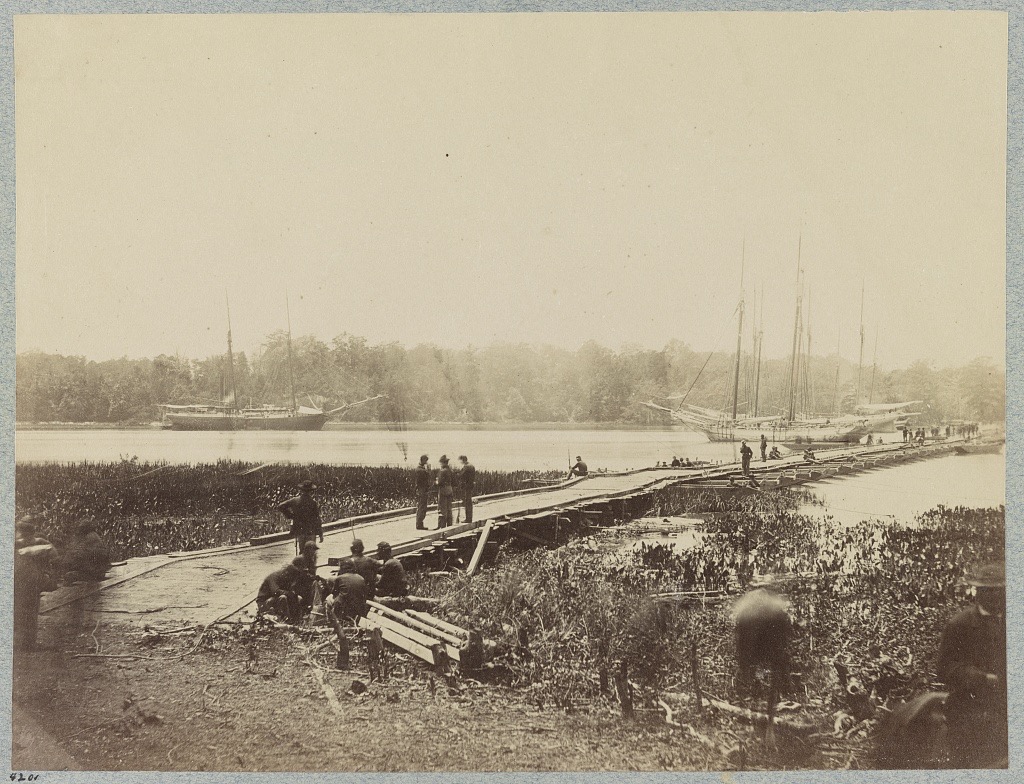
On June 12, 1864, one of the most daring logistical operations of the Civil War began as more than one hundred thousand soldiers of General Ulysses S. Grant’s Union army quietly pulled away from their lines and started the historic crossing of the James River. After the bloody stalemate at Cold Harbor, Grant made the bold decision to break contact with Robert E. Lee entirely and shift his entire force south — a maneuver no Union commander had ever attempted. To carry an army of this size across a deep tidal river without permanent bridges, Union engineers assembled an extraordinary two‑thousand‑foot pontoon span in roughly eight hours, the longest floating bridge constructed during the war.
The movement was executed with such secrecy and precision that the Confederate high command did not realize the Union trenches had been abandoned until Grant’s columns were already marching toward Petersburg, the vital rail junction feeding Richmond. Although the first Union assaults on Petersburg faltered due to hesitation among field commanders, the successful crossing of the James fundamentally reshaped the war. It forced Lee into a defensive siege he could not escape, stretching his dwindling manpower across miles of entrenchments. The ten‑month struggle that followed slowly strangled the Confederacy’s last major army, setting in motion the chain of events that would bring down both Petersburg and Richmond the following spring.