
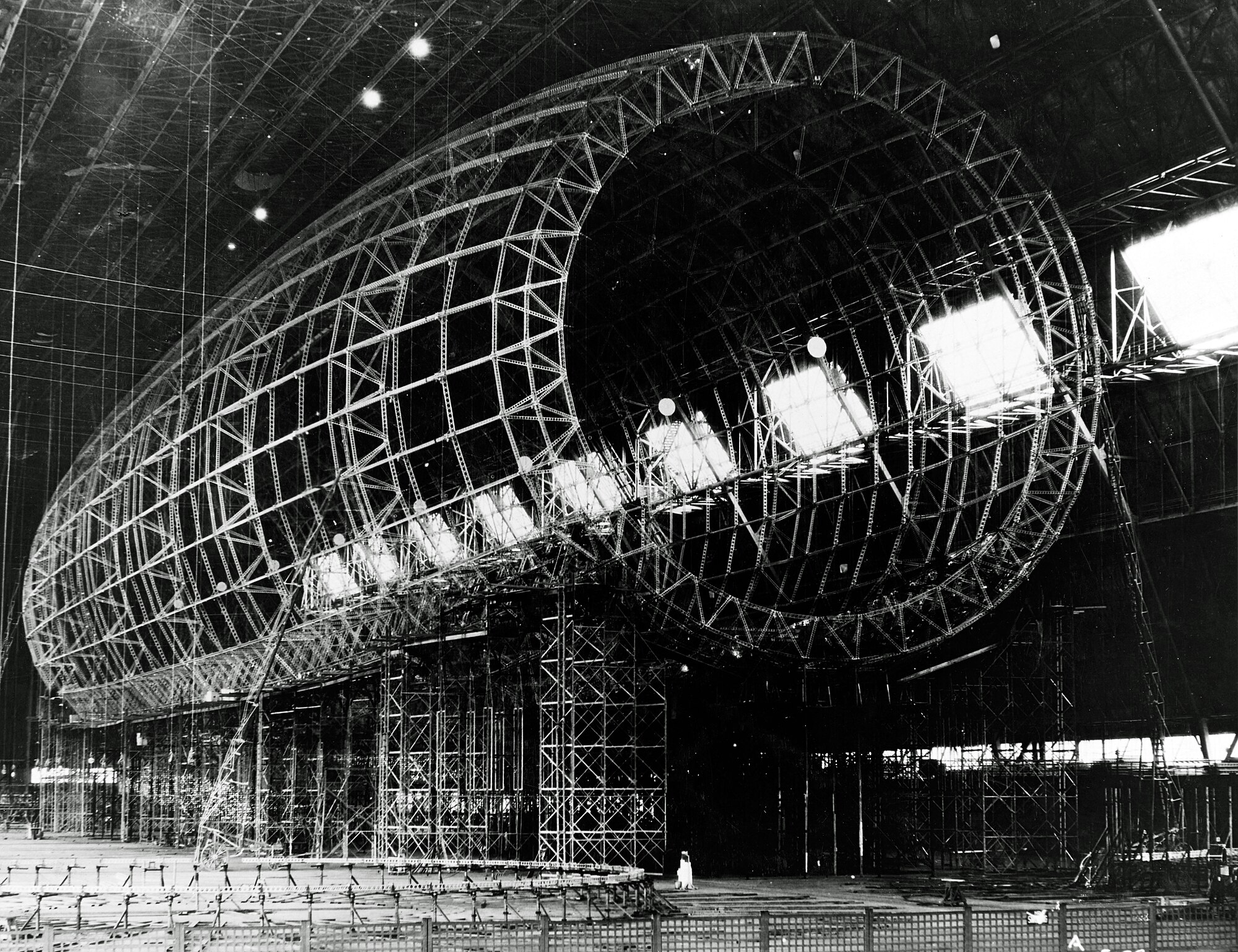
On October 6, 1928, the U.S. Navy awarded the Goodyear-Zeppelin Corporation of Akron, Ohio, a landmark fixed-price contract of about $7.8 million to build two enormous rigid airships. Formed through an agreement between Goodyear and Germany’s Luftschiffbau Zeppelin, Goodyear-Zeppelin possessed the specialized engineering expertise needed for a project of this unprecedented scale. The contract was formally signed on October 16, beginning one of the Navy’s most ambitious experiments in lighter-than-air aviation.
The resulting vessels—USS Akron and USS Macon—were designed as aerial scouts and became the world’s first purpose-built operational flying aircraft carriers. Each incorporated an internal hangar and a retractable trapeze mechanism that could launch and recover Curtiss F9C Sparrowhawk fighters while the airship was in flight. Using a hook mounted above the upper wing, a Sparrowhawk pilot could connect to the trapeze beneath the airship and be hoisted back into the hangar. This system was intended to extend the scouting reach of the U.S. fleet, particularly across the immense distances of the Pacific.
Their promise was short-lived. USS Akron was lost in a severe storm off New Jersey on April 4, 1933, killing 73 of the 76 people aboard. USS Macon was lost in stormy weather off Point Sur, California, on February 12, 1935, after damage to its tail structure led to a loss of control. The destruction of both ships ended the Navy’s rigid-airship carrier program and left the Akron and Macon as extraordinary, if tragic, milestones in naval aviation history.