
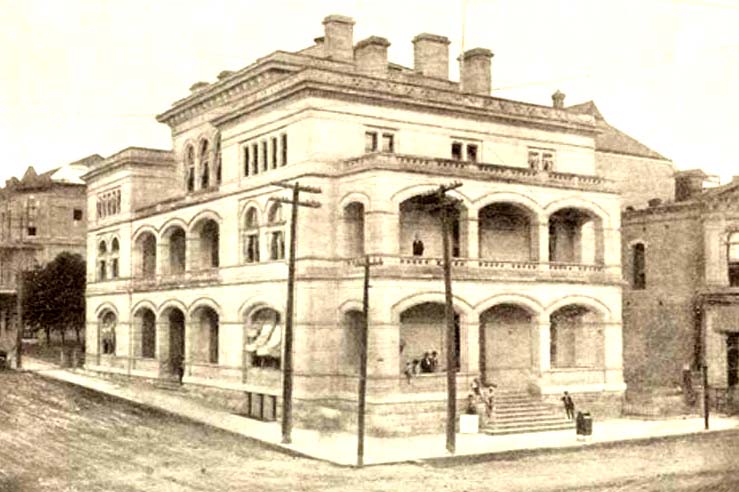
On October 14, 1936, the practical administration of President Franklin D. Roosevelt’s New Deal reached a consequential milestone when the nation’s first Social Security field office opened in Austin, Texas. Established just over a year after Roosevelt signed the Social Security Act of 1935, the office was charged with turning a sweeping and contested federal law into an operational reality for ordinary Americans. Its opening marked the beginning of a nationwide administrative network intended to provide long-term economic security for retired workers.
The new agency found its home in a building already deeply woven into the legal and institutional history of Texas. Completed in 1879 and designed by architect James G. Hill, with construction supervised in part by prominent Texas builder Abner Cook, the limestone structure had long served as Austin’s U.S. Court House and Post Office. Its federal courtroom had been the site of high-stakes frontier justice for decades, most famously hosting William Sydney Porter’s February 1898 embezzlement trial and conviction; Porter would later achieve literary fame under the pen name O. Henry. When the federal courts vacated the building in 1936, it cleared the way for a new kind of federal presence.
Operating from the newly available landmark, the embryonic field office began with a remarkably small staff. Fred Rogers (no relation to the television host) served as its first district manager and, initially, its only employee. Working with worn desks and chairs left behind by the Post Office, Rogers was tasked with explaining the novel program to employers, answering public inquiries, and building the casework procedures that would soon guide a rapidly expanding national system across Texas. Although the U.S. Postal Service handled the initial distribution and collection of Social Security number applications, the Austin office established the enduring model for localized federal outreach.
The original Social Security Act did not yet include the survivors’ or disability benefits that later became central to the program. Survivors’ benefits were added in 1939, while disability insurance followed in 1956. Nevertheless, the opening of the Austin office marked the moment when Social Security ceased to be merely a law on paper and became a visible public institution. Decades later, the historic structure was acquired by the University of Texas System and renamed O. Henry Hall; in 2015, it was purchased by the Texas State University System. Today, it stands as a monument to Austin’s institutional evolution—a 19th-century house of justice transformed into an early and enduring symbol of the modern American safety net.
