
Long before the American Revolution, French colonists attempted to establish a foothold on the marshy banks of Florida’s St. Johns River. In 1564, René Goulaine de Laudonnière founded Fort Caroline, a small French settlement near the river’s mouth. The colony was a strategic challenge to Spanish claims in Florida and a possible commercial base, but it also became a refuge for Huguenots—French Protestants facing persecution in a deeply divided France.
For its inhabitants, French Florida offered the possibility of a new beginning. Colonists sought to build a community, secure food and trade, and establish relationships with Timucua-speaking peoples in the region. Yet the settlement faced shortages, internal instability, and the larger contest between Catholic Spain and Protestant France for power in the Atlantic world.
That contest turned deadly in September 1565. Pedro Menéndez de Avilés had founded St. Augustine on September 8, creating a Spanish base south of Fort Caroline. When a French expedition sailed out from Fort Caroline to confront the Spaniards, a hurricane scattered and wrecked much of its fleet. Menéndez seized the opportunity. Through heavy rain and difficult terrain, Spanish troops marched north and launched a surprise attack on Fort Caroline at dawn on September 20.
The assault was swift and devastating. Spanish forces killed most of the French men inside the fort, while many women and children were taken prisoner and a number of defenders, including Laudonnière, escaped. The fort was renamed San Mateo and briefly occupied by Spain. In the following weeks, Spanish forces also killed many shipwrecked French survivors at Matanzas Inlet, where religious identity was explicitly invoked in the killings.
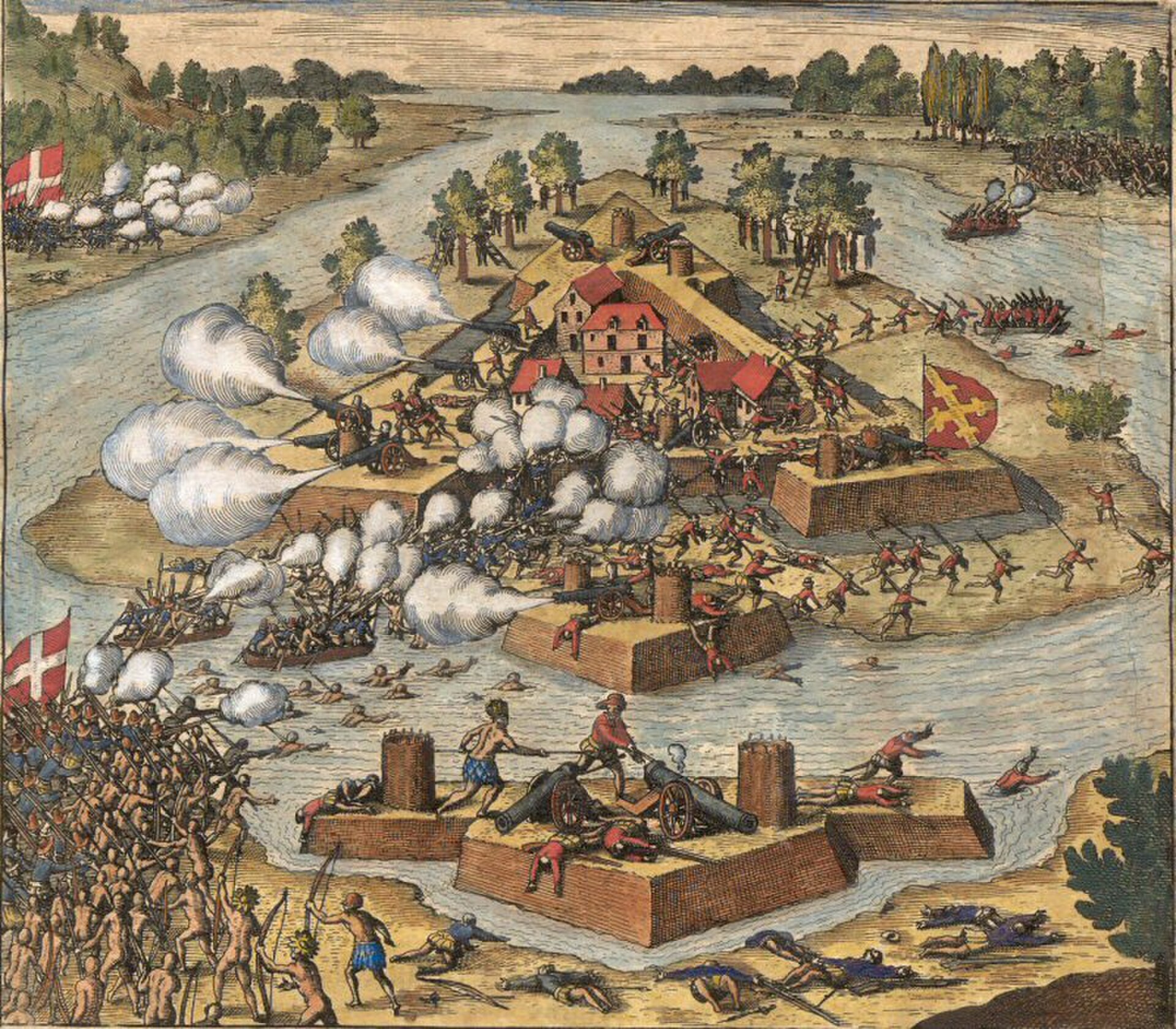
Theodore de Bry’s later engraving preserves an idealized visual memory of Fort Caroline, though it should be read carefully rather than as a precise architectural record. De Bry based his Florida images partly on work associated with the artist Jacques Le Moyne, while also reshaping material for a European print market eager for scenes from the Americas. Fort Caroline’s fall was more than the destruction of a small settlement. It marked the collapse of France’s first sustained Florida colony and strengthened Spain’s hold over the region. Its story reveals how Indigenous diplomacy, European imperial competition, religious conflict, and environmental disaster shaped the earliest colonial history of what is now the United States.
