
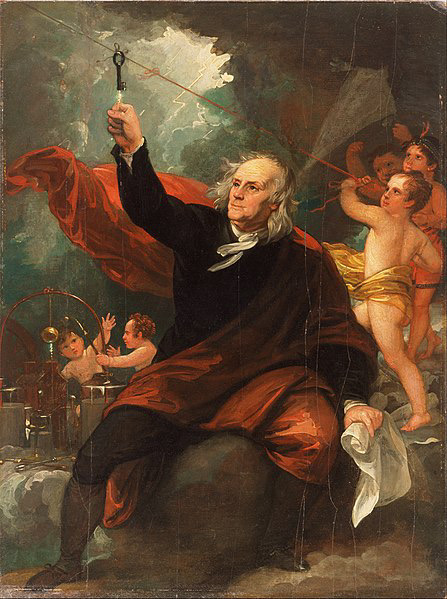
On June 15, 1752, American philosopher and scientist Benjamin Franklin is believed to have conducted his legendary kite experiment in Philadelphia, an audacious attempt to prove that lightning was a form of electricity rather than an act of divine wrath. Accompanied by his son William, Franklin raised a simple silk kite equipped with a pointed iron wire into the dark clouds of an approaching thunderstorm, grounding the wet twine with a silk ribbon and attaching a common iron key to the bottom. When the localized storm clouds passed over the apparatus, Franklin observed the loose fibers of the hemp twine standing on end, and when he moved his knuckle toward the key, he successfully drew a sharp, unmistakable spark of ambient electrical current.
This experiment fundamentally transformed the global understanding of natural forces, catapulting Franklin to international scientific fame and dismantling centuries of superstition surrounding severe weather. He quickly applied his breakthrough findings to invent the lightning rod, a simple but revolutionary safety device that successfully protected homes, churches, and ships from devastating fires by safely redirecting electrical strikes into the ground. While popular art and mythology frequently depicted Franklin surrounded by cherubs or performing the dangerous stunt completely exposed in an open field, the actual historical event was a calculated, indoor observation conducted from the safety of a cow shed to ensure the rain did not ruin the crucial silk insulation.
The reliance on June 15th as the definitive historical marker is established through meticulous historical deduction, as Franklin himself never recorded the exact calendar day in his own writings. The most definitive evidence for the mid-June timeline comes from British scientist Joseph Priestley, who worked directly with Franklin to publish the first comprehensive account of the experiment in 1767. Nineteenth-century biographers later cross-referenced Priestley’s June timeline with Philadelphia weather diaries from 1752 to pinpoint mid-June as the only period marked by the specific afternoon thunderstorms required for the launch. Furthermore, because Franklin did not publish the experiment instructions in his newspaper until October, historians conclude that a June 15th date fits the exact multi-month window he required to repeat his observations, construct his early lightning rods, and safely draft his scientific reports for the Royal Society in London.
