
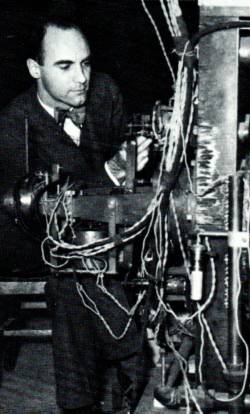
On September 3, 1905, American physicist Carl D. Anderson was born in New York City. His work would eventually transform scientists’ understanding of matter—and reveal that every familiar particle might have an opposite counterpart.
In 1932, while studying cosmic rays at the California Institute of Technology, Anderson discovered the positron: the electron’s antimatter counterpart, or antiparticle. It was the first antiparticle established experimentally and provided decisive evidence that antimatter was more than a mathematical possibility. Four years later, at age 31, Anderson shared the 1936 Nobel Prize in Physics with Victor Hess; Anderson was honored specifically “for his discovery of the positron.”
Anderson made the breakthrough with a cloud chamber placed in a magnetic field. Charged particles passing through the chamber left visible tracks, and the magnetic field bent those tracks according to the particles’ charge and momentum. In a now-famous 1932 photograph, Anderson observed a track from a particle with a mass consistent with an electron—but curving in the direction expected for a positive charge. The key evidence came from a lead plate inside the chamber: as the particle passed through it, it lost energy and its path curved more sharply, revealing that it was moving upward. This ruled out the possibility that it was simply a proton traveling in the opposite direction.
The particle became known as the positron, or “positive electron.” Its discovery confirmed a startling prediction made by physicist Paul Dirac and opened the door to modern particle physics, where antimatter is now understood as a fundamental feature of nature rather than science fiction.
Anderson was not originally hunting for antimatter. He was investigating cosmic rays and initially had to carefully test whether the unusual tracks could be explained by known particles or by an experimental misunderstanding. That methodical skepticism was essential: by adding the lead plate and analyzing the track’s curvature, he turned an unexpected image into the first clear experimental identification of antimatter.
Image: Carl D. Anderson, c. 1937, via Wikimedia Commons, public domain
