
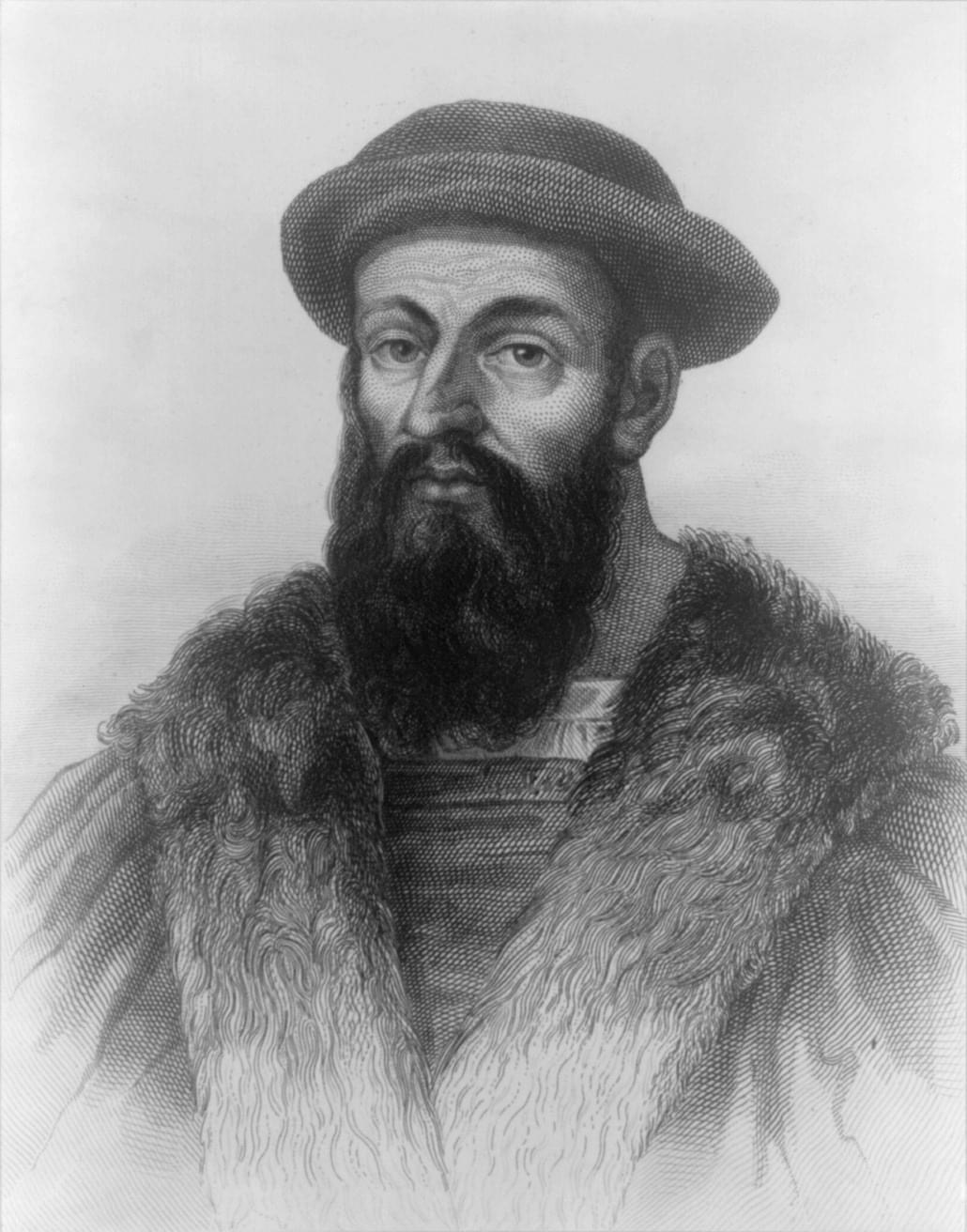
On September 20, 1519, Portuguese navigator Ferdinand Magellan and his crew departed Sanlúcar de Barrameda, Spain, on an expedition intended to find a westward route to the spice-rich Moluccas, or Spice Islands, in present-day Indonesia. Sailing under the authority of King Charles I of Spain, Magellan commanded five ships and a multinational crew of about 270 men. His goal was to locate a navigable passage through—or around—the newly encountered American continents and open a Spanish route to the Asian spice trade.
The expedition faced immense logistical challenges from the outset. The sailors endured harsh weather, food shortages, disease, conflict with Indigenous peoples, and a major mutiny while wintering on the coast of Patagonia. In late 1520, the fleet discovered and navigated the passage now known as the Strait of Magellan, reaching the ocean Magellan named the Pacific.
In March 1521, roughly 18 months after leaving Spain, the expedition reached Guam in the Mariana Islands—now an unincorporated U.S. territory—before continuing to the Philippines. The voyage dramatically expanded European geographic knowledge by revealing the extraordinary breadth of the Pacific and demonstrating the practical connection among the Atlantic, Pacific, and Indian Oceans.
Magellan was killed in the Battle of Mactan in the Philippines in April 1521 and therefore did not complete the journey. The surviving expedition continued under Juan Sebastián Elcano. On September 6, 1522, the battered Victoria, the sole surviving ship of the original fleet, returned to Sanlúcar de Barrameda with 18 men aboard. Their arrival completed the first recorded circumnavigation of the globe, nearly three years after the expedition had begun.
Image: Ferdinand Magellan via Wikimedia Commons, public domain