
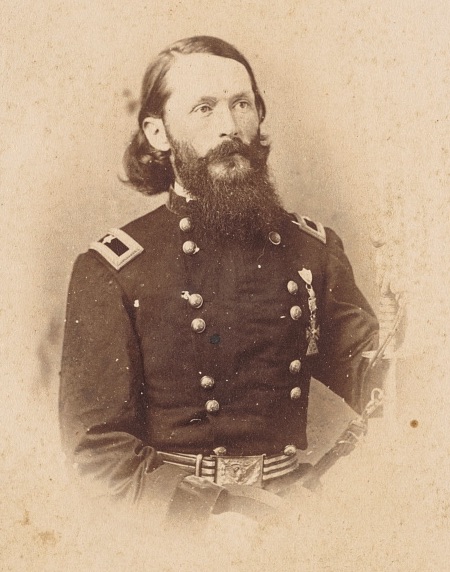
Brig. Gen. William Haines Lytle was a prominent Union officer from Cincinnati, Ohio, as well as a lawyer and poet. Before becoming a brigadier general, he served with the 10th Ohio Infantry and gained experience in the early western campaigns of the Civil War. By the fall of 1862, Lytle commanded a brigade in the Army of the Ohio, one of the Union forces sent to prevent Confederate troops from establishing a lasting hold on Kentucky. The Battle of Perryville took place on October 8, 1862, near Perryville, Kentucky. It was the culminating clash of Confederate Gen. Braxton Bragg’s Kentucky Campaign, an offensive intended to draw Kentucky into the Confederacy, obtain supplies, and weaken Union influence in the border state. Union forces under Maj. Gen. Don Carlos Buell confronted Bragg’s army in dry, difficult terrain, where shortages of water affected both soldiers and civilians.
Lytle’s brigade fought in some of the heaviest action of the day. During the battle, he was wounded and captured by Confederate forces. He was later exchanged and returned to Union service, continuing his military career until he was killed at the Battle of Chickamauga in September 1863. Perryville was the largest Civil War battle fought in Kentucky and produced severe casualties, with thousands of Union and Confederate soldiers killed, wounded, captured, or missing. Although the Confederate army won important tactical successes on parts of the battlefield, Bragg withdrew from Kentucky soon afterward. The campaign therefore failed to bring Kentucky into the Confederacy or establish durable Confederate control there.
The battle’s larger significance lay in its strategic consequences. After Perryville, the Union retained control of Kentucky for the remainder of the war, despite later Confederate raids and incursions. For Union leaders, that outcome was especially important: Kentucky’s rivers, railroads, agricultural resources, and location between the North and the Deep South made it one of the war’s most valuable border states.
