
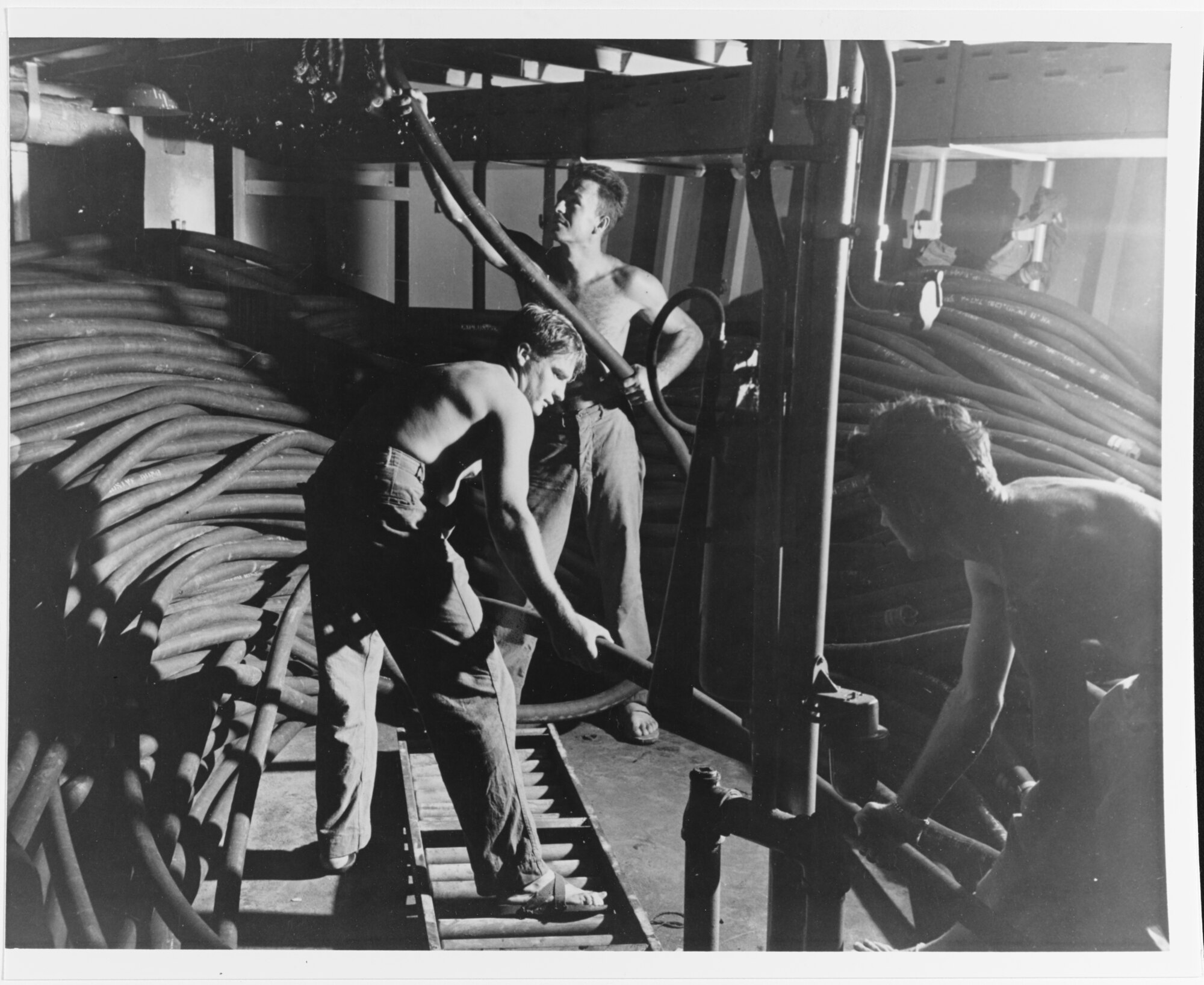
On September 15, 1944, during the Allied invasion of Morotai Island in the Netherlands East Indies, personnel from a U.S. Navy combat demolition unit prepared and detonated explosives to clear a channel through shallow-water obstacles near the landing area. The operation used TNT contained in specially prepared rubber hose, allowing the demolition team to place explosive charges in long, narrow lines through the obstruction.
The work supported Operation Trade Wind, in which General Douglas MacArthur’s forces landed on Morotai to establish airfields for the coming campaign in the Philippines. Morotai’s reefs created some of the worst landing conditions encountered by Allied forces in the Southwest Pacific: troops and equipment often had to move through difficult shallow water and reef formations. Clearing a channel helped improve access for landing craft and the broader amphibious force.
The blast at Morotai was substantial. Contemporary Navy imagery identifies the work as channel blasting by a Navy combat-demolition unit, while a later historical account reports that the explosion used more than eight tons of TNT and scattered debris across roughly 800 yards.
The operation illustrates the hazardous, highly technical role of the Navy’s World War II Underwater Demolition Teams. These units reconnoitered beaches, removed obstacles, and opened approaches for amphibious landings—functions that helped shape the lineage later associated with the U.S. Navy SEALs.
Image: Men of a U.S. Navy combat-demolition unit prepare TNT for blasting out a channel at Morotai Island, September 15, 1944. U.S. Naval History and Heritage Command; public domain.
