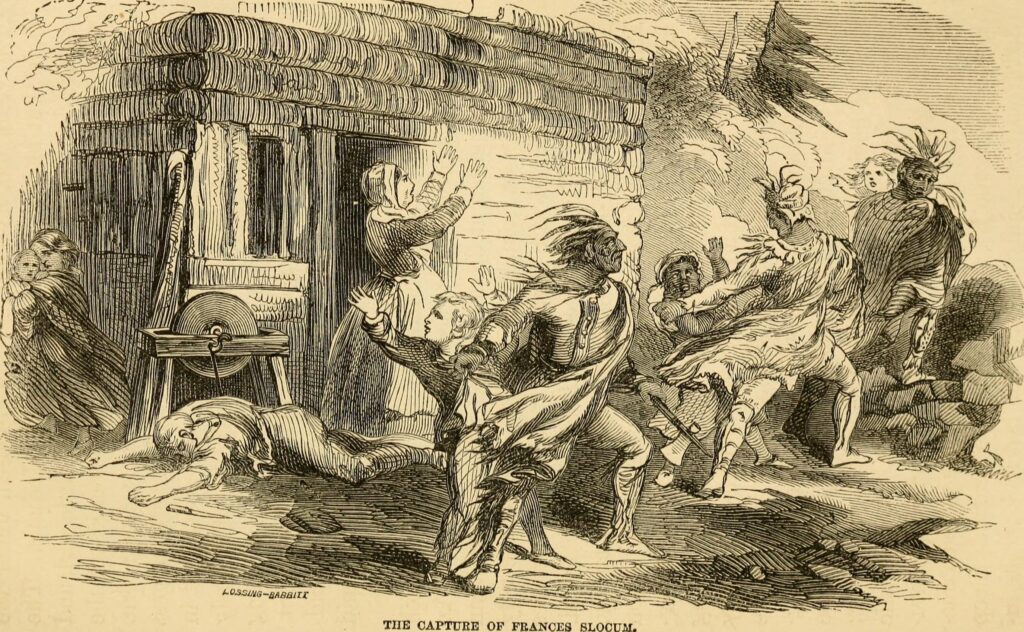
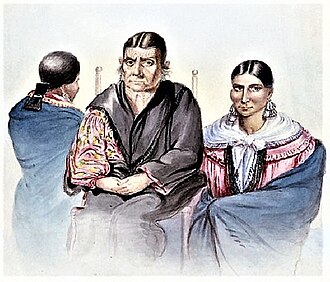
Frances Slocum sits at the center of George Winter’s 1839 portrait with her two daughters. Nearly sixty-one years earlier, on November 2, 1778, Lenape warriors had taken her from her family’s home near Wilkes-Barre, Pennsylvania. She was five years old.
Adopted and raised by a Lenape family, she later married Miami chief Shepoconah and made her home along Indiana’s Mississinewa River. Known as Maconaquah, a name often translated as “Little Bear” or “Young Bear,” she built a life far from the Pennsylvania family that continued searching for her. When her surviving siblings finally found her in 1837, she chose to remain with her Miami family.
In the following years, that home came under threat as the United States pressed the Miami to leave Indiana. Slocum sought her brothers’ help in petitioning Congress for permission to stay. On March 3, 1845, Congress granted an exemption protecting her and 21 members of her Miami community from removal westward. She had not saved an entire nation, but she had helped secure something deeply consequential: the right of her family and relatives to remain.
Beside her in Winter’s portrait are her daughters, Kekenakushwa, or Cut Finger, and Ozahshinquah, or Yellow Leaf. Winter’s account describes a reluctant sitting. Frances had agreed to the portrait for her brother’s sake, but questioned its purpose and worried that the artist would charge her. Afterward, her widowed daughter refused to look at the likeness; in the family portrait, she appears with her back toward the viewer.
The image preserves more than the story of a child taken from Pennsylvania. It shows Maconaquah as the woman she became—a mother whose family and home were among the Miami, and who chose to stay with them.