
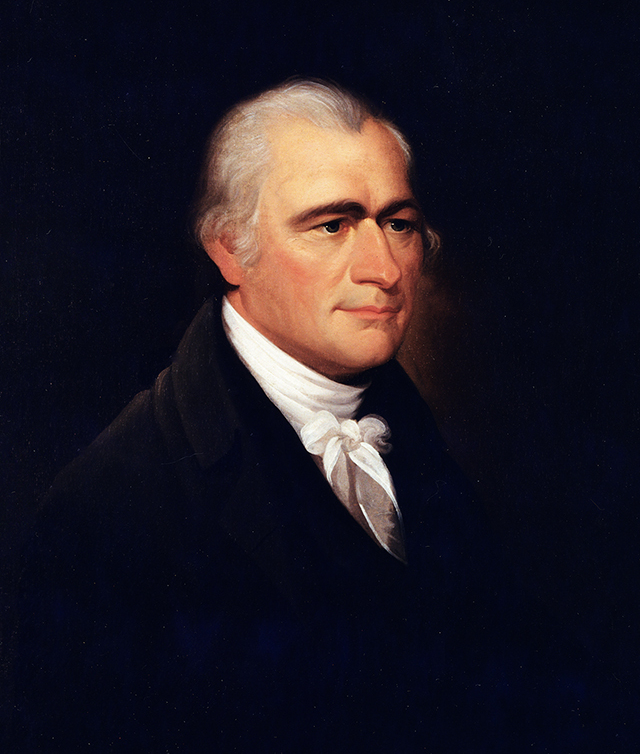
On October 27, 1787, the first essay of The Federalist Papers appeared in New York’s Independent Journal, signed with the pseudonym “Publius.” Alexander Hamilton, James Madison, and John Jay would use that shared name to make the case for ratifying the proposed United States Constitution. The name invoked Publius Valerius Publicola, traditionally remembered as a founder of the Roman Republic—a fitting reference for writers arguing over the future of an American republic.
In Federalist No. 1, Hamilton confronted his readers with a question whose significance reached beyond the immediate ratification debate: could human societies establish good government through “reflection and choice,” or were they forever destined to depend on “accident and force”? By framing the decision this way, he presented ratification as a test of deliberate self-government, setting an ambitious philosophical tone for the 84 essays that followed.
Writing under a shared pseudonym followed a familiar practice in the political debates of the period, helping direct attention toward the arguments rather than the authors’ personalities. Yet that shared identity also left a lasting puzzle: Hamilton and Madison later claimed overlapping credit for twelve essays. In the 1960s, statisticians Frederick Mosteller and David Wallace analyzed patterns in the writers’ language, producing influential evidence that the disputed papers were Madison’s—a striking meeting of eighteenth-century political argument and twentieth-century statistical analysis.
