
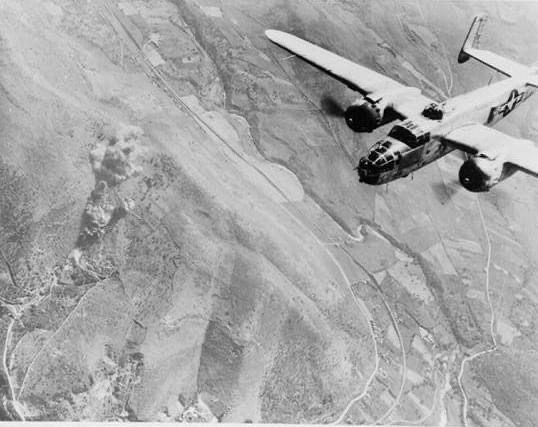
On August 19, 1940 the B-25 Mitchell bomber made its first flight.
The maiden flight of the North American B-25 Mitchell on August 19th introduced an exceptionally versatile, twin-engine medium bomber that would become an industrial colossus of Allied aerial power during World War II. Engineered to carry a heavy payload with tactical speed and agility, the aircraft was named to honor General Billy Mitchell, the visionary pioneer who had sacrificed his military career to advocate for an independent American air service. The prototype flight successfully validated the radical gull-wing configuration and twin-tail design, proving to military observers that the plane possessed the structural integrity to operate across every major theater of the global conflict.
Operating across the frozen fields of Russia, the dense jungles of Burma, and the sun-baked hills of Italy, the B-25 won a peerless reputation among crews for its rugged durability and lethal firepower. The absolute masterstroke of the aircraft’s wartime career occurred in April 1942, when Lieutenant Colonel Jimmy Doolittle executed a daring, high-stakes mission, launching sixteen heavily modified Mitchell bombers off the short wooden deck of the aircraft carrier USS Hornet to strike Tokyo. This unprecedented operation delivered a massive psychological boost to a battered American public, proving that no Axis stronghold was safe from Allied retaliation.
The image of a B-25 pounding Nazi supply centers over Tivoli beautifully illustrates the aircraft’s devastating precision during the critical campaigns to liberate southern Europe. By systematically shredding Axis rail hubs, bridges, and ammunition dumps ahead of advancing Allied infantry units, these low-altitude bombers choked off enemy logistics and accelerated the collapse of the fascist regime. The Mitchell bomber stood as a permanent monument to American mass-production ingenuity, turning out nearly 10,000 airframes that continuously dominated the skies to secure global democracy.
Image: A heavy B-25 Mitchell bomber executing a precision low-altitude strike over a Nazi supply hub near Rome in the 1940s via Wikimedia Commons, public domain
