
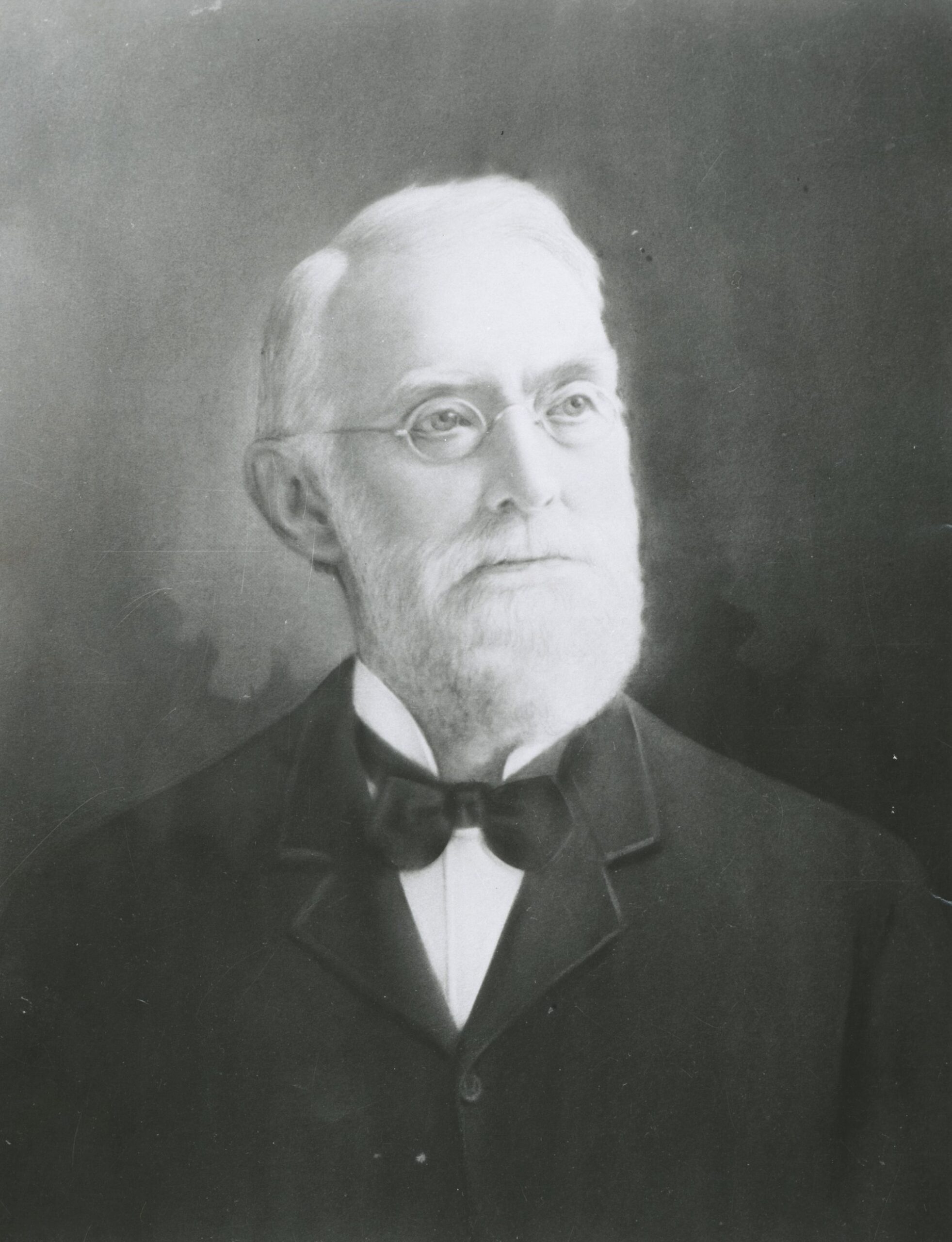
On September 5, 1829, inventor and mechanic Lester Allan Pelton was born in Vermilion, Ohio. He would go on to create the Pelton water wheel—an invention that made it far more practical to harness the kinetic energy of fast-moving water at high-elevation sites.
Pelton traveled to California during the Gold Rush but did not strike it rich. Instead, he worked as a carpenter and millwright, eventually settling in the Sierra mining country near Camptonville. There, mines relied on water-powered machinery to run stamp mills and other equipment, but the available turbine designs did not use the region’s high-head mountain streams as efficiently as they could.
According to a widely repeated account, Pelton’s breakthrough came in the late 1870s while he watched a water turbine whose wheel had slipped slightly out of alignment with its jet. Rather than hitting the middle of a cup, the stream struck near its edge and was redirected in a broad arc. The wheel reportedly ran faster—suggesting that efficiency improved when the water’s motion was reversed rather than merely splashed or stopped.
Pelton developed that observation into a distinctive impulse turbine. Its double-cupped buckets have a central splitter ridge that divides the incoming jet into two streams and turns the water back on itself. That change extracts far more of the water jet’s momentum, making the design particularly effective for high-head, relatively low-flow mountain water sources.
A Pelton wheel was installed at the Mayflower Mine in Nevada City in 1878, and in 1887 a miner coupled one to a dynamo to produce what is commonly described as the first hydroelectric power in the Sierra Nevada. Pelton received the Franklin Institute’s Elliott Cresson Medal in 1895 for his contribution to engineering.
More than a century later, the underlying design remains central to Pelton turbines, which are still used in hydropower systems where water descends from great heights through a narrow jet.
Image via Wikimedia Commons, public domain
