
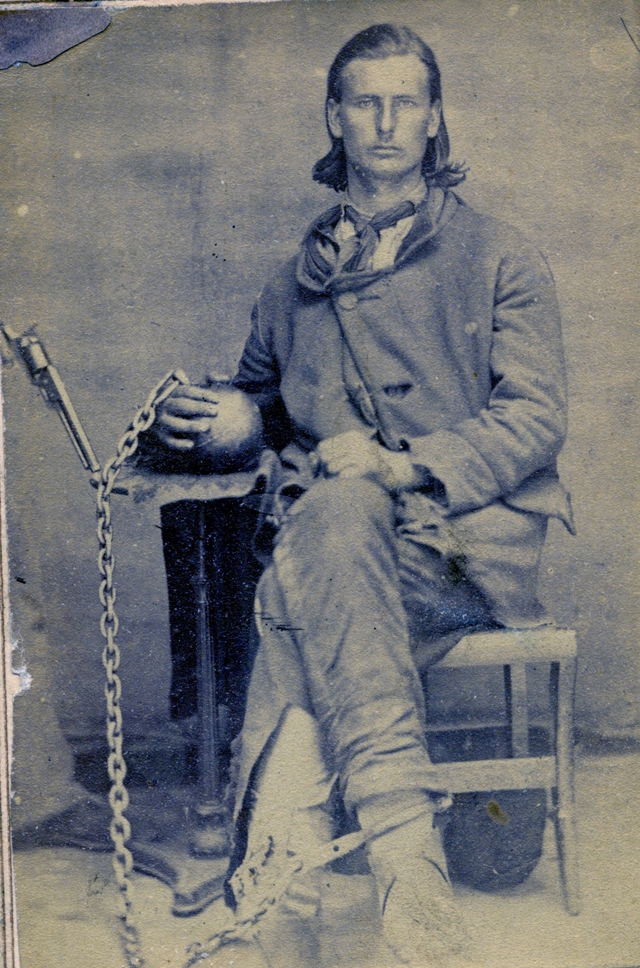
On October 30, 1863, twenty-two-year-old John Nichols was hanged outside Jefferson City, Missouri, after a military commission convicted him of operating as a guerrilla. Witnesses accused him of threatening civilians, shooting at them, stealing horses, and committing robberies across Pettis, Henry, and Johnson counties. A photograph taken during his confinement preserves a stark image of his captivity: Nichols sits in leg irons attached to a ball and chain, while part of a guard’s leg and a revolver appear along the left edge. An inscription beneath the image records his name and execution date.
Nichols’s case reveals the contested boundary between soldiering and criminal violence in Missouri’s guerrilla war. Tried before a military commission in June 1863, he maintained that he was a Confederate officer and described his seizures of horses and weapons as part of recruiting missions. Eight witnesses, however, testified to violence and intimidation against local residents. His sentence was reviewed and confirmed by Missouri Governor Hamilton Gamble and President Abraham Lincoln. In a statement dictated before his execution, Nichols also acknowledged killing an enslaved man named George, whom he accused of helping others capture him.
On the day of his execution, Nichols rode to a scaffold in a ravine about a mile outside town, seated on his coffin. According to an eyewitness account, he placed the noose around his own neck and declared, “Gentlemen, I am going to show you how a Confederate soldier dies.” Those were not his last reported words: after speaking with a priest, he called out, “Goodbye boys, everybody,” before the trap fell. Preserved in the photograph is more than the image of a condemned young man. It is a reminder of a war fought through civilian intimidation, disputed claims of military legitimacy, and lethal punishment far from the major battlefields.
