
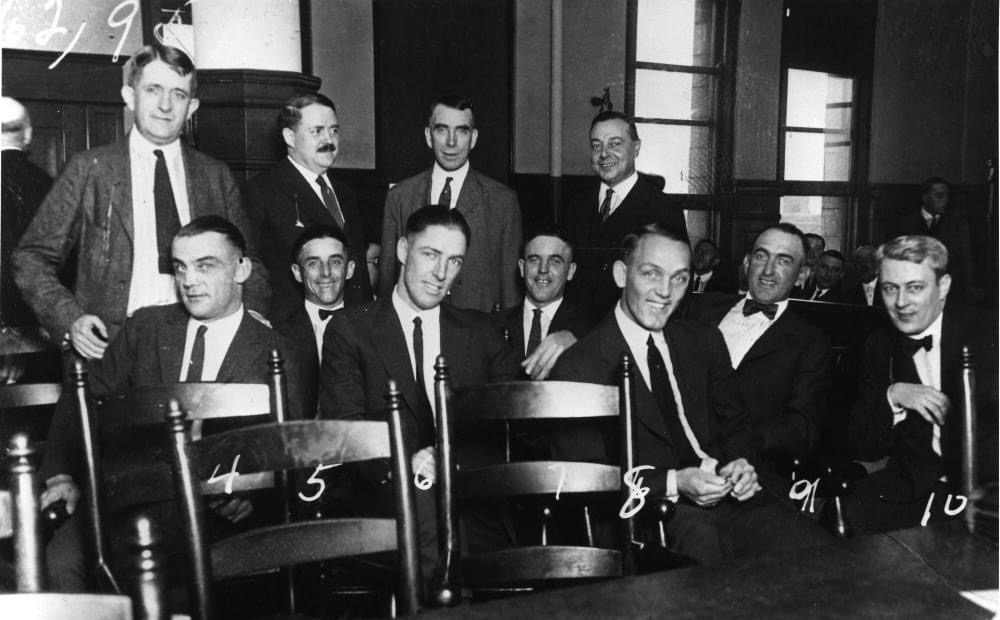
The integrity of professional sports was profoundly shaken in late September 1920, when members of the Chicago White Sox appeared before a Cook County grand jury investigating allegations that the club had deliberately lost the 1919 World Series. The heavily favored White Sox—often called the “Pale Hose”—had lost the championship to the Cincinnati Reds amid persistent rumors that players had accepted gamblers’ money to throw the Series.
On September 28, pitcher Eddie Cicotte and outfielder Joe Jackson gave sworn testimony admitting involvement in the scheme; pitcher Lefty Williams followed the next day. Their statements, together with information gathered from other participants and witnesses, helped drive an investigation that soon produced indictments against eight White Sox players on conspiracy-related charges. Happy Felsch also admitted involvement during the investigation, although he was not among the players whose grand-jury testimony formed the central evidentiary record.
The scandal exposed long-running tensions within the White Sox clubhouse. Players resented owner Charles Comiskey’s reputation for penny-pinching and restrictive treatment, but those grievances do not fully explain their decision to participate in a fix. Public accounts often connected the gambling operation to New York gambler Arnold Rothstein, yet prosecutors never obtained sufficient evidence to indict him in the conspiracy.
In 1921, the accused players were acquitted in a controversial criminal trial. Accounts often say that the disappearance of grand-jury materials and supposed confessions doomed the prosecution, but the record is more complicated: stenographers reconstructed missing grand-jury transcripts from shorthand notes, and redacted versions were read at trial. Historians have argued that the vanished materials were not the sole—or necessarily decisive—reason for the acquittal.
The legal verdict did not restore the players to baseball. On August 3, 1921, Commissioner Kenesaw Mountain Landis permanently barred the eight implicated White Sox players, including “Shoeless” Joe Jackson, from Organized Baseball. The ruling established baseball’s enduring zero-tolerance posture toward gambling and remains the defining institutional response to the sport’s greatest integrity crisis.
Image via Wikimedia Commons, public domain.
