
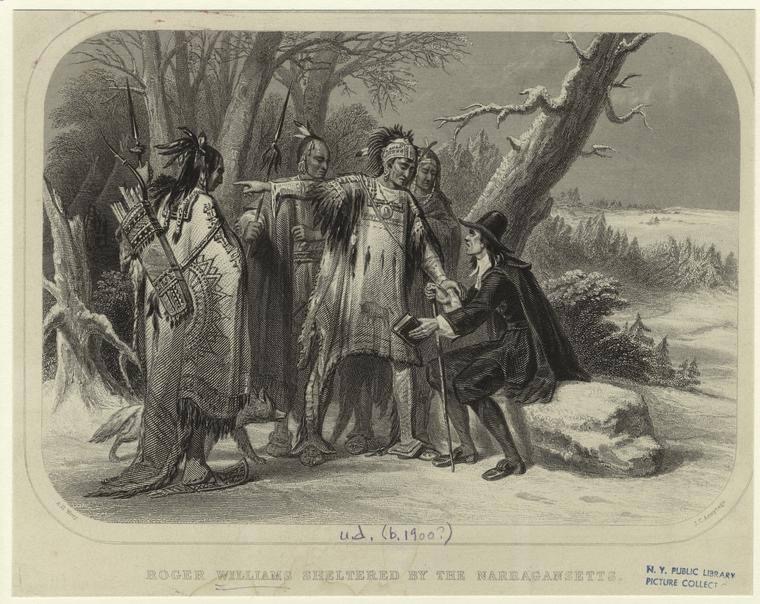
On October 9, 1635, the General Court of the Massachusetts Bay Colony sentenced Roger Williams—a radical Puritan minister and the future founder of Providence—to banishment for promoting what officials called “new and dangerous opinions.” Williams had challenged the Puritan colony’s religious order, arguing that civil authorities had no right to regulate individual conscience or enforce religious belief. He also condemned English claims to Indigenous lands made through royal charters without the consent of the Native peoples who lived there.
Although the court initially allowed Williams to remain until spring if he stopped publicly teaching his views, he fled Massachusetts during the winter of 1636 when authorities prepared to remove him. After receiving permission from Narragansett leaders Canonicus and Miantonomi, he established Providence in 1636. The settlement became a refuge for religious dissenters and was grounded in Williams’s principle of “liberty of conscience”: civil government should govern civil affairs, not religious faith.
Williams’s banishment marked a major moment in the history of religious liberty in North America. His defense of conscience, his insistence on fairer dealings with Native peoples, and his separation of civil authority from religious authority helped shape ideas that would later become central to American debates over religious freedom and the relationship between church and state.
