
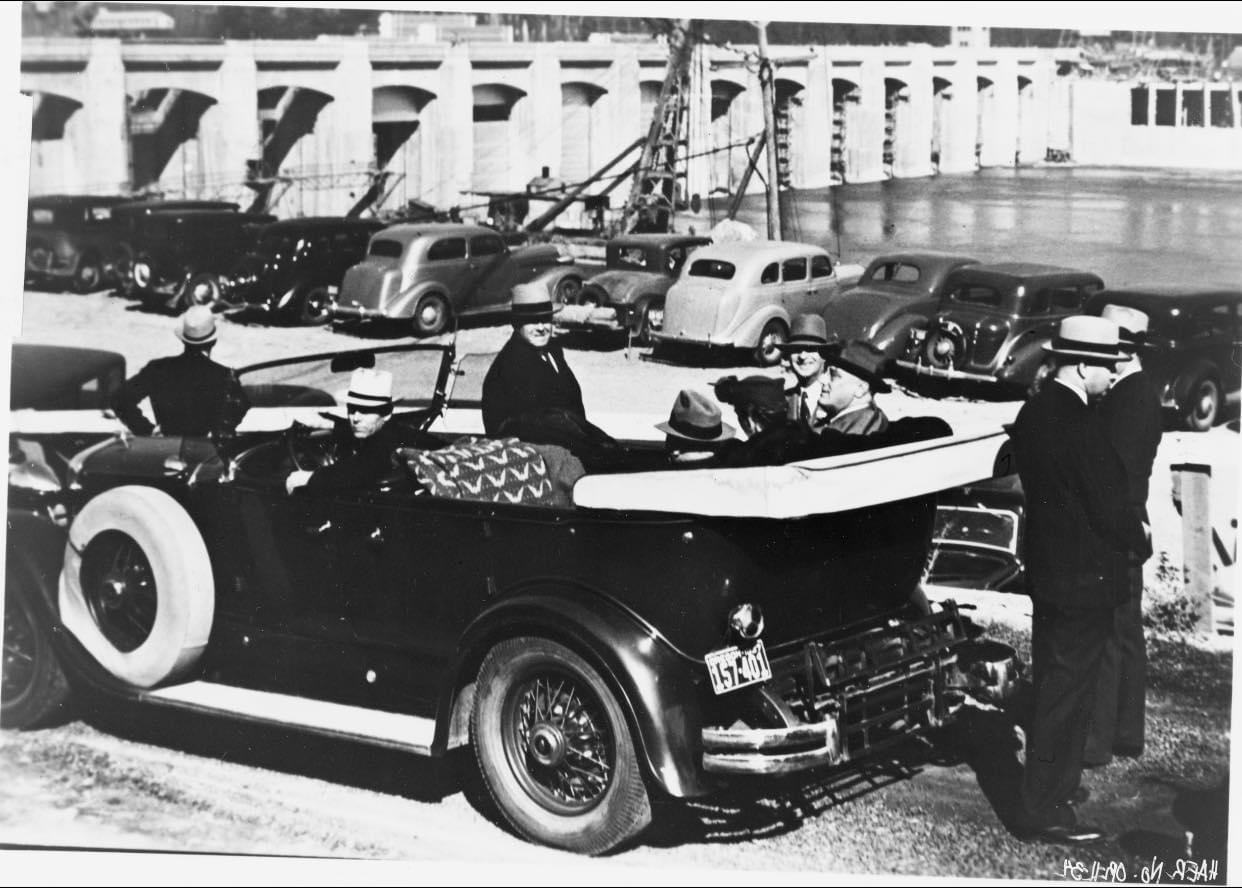
On September 28, 1937, President Franklin D. Roosevelt arrived at Bonneville Dam on the Columbia River to dedicate one of the New Deal’s most ambitious public-works projects. Straddling the Oregon–Washington border, the massive complex—built by the U.S. Army Corps of Engineers—was designed to put people to work during the Great Depression while transforming the river into a source of electric power and commercial transportation. Although Roosevelt’s ceremony celebrated the project’s progress, the original dam, powerhouse, and navigation lock were not fully completed until 1938.
In his address, Roosevelt presented Bonneville as a public investment meant to spread the benefits of cheap hydroelectricity across the Pacific Northwest. He envisioned widespread electrification of the region, with power serving homes, farms, and industry. The project also included a navigation lock intended to make the Columbia more usable for river commerce, as well as fish-passage facilities—ladders, lifts, and bypass systems—developed to help salmon and steelhead migrate past the dam.
Within a few years, Bonneville’s inexpensive electricity became a major asset in the American war effort. Power distributed through the Bonneville Power Administration supported aluminum production, shipyards, aircraft manufacturing, and other wartime industries; by 1943, 12 large aluminum plants operated in the Northwest and accounted for 60 percent of BPA power sales. Bonneville’s dedication thus foreshadowed the Columbia River’s transformation into a central engine of the industrial Pacific Northwest.
Image via Wikimedia Commons, public domain.
