
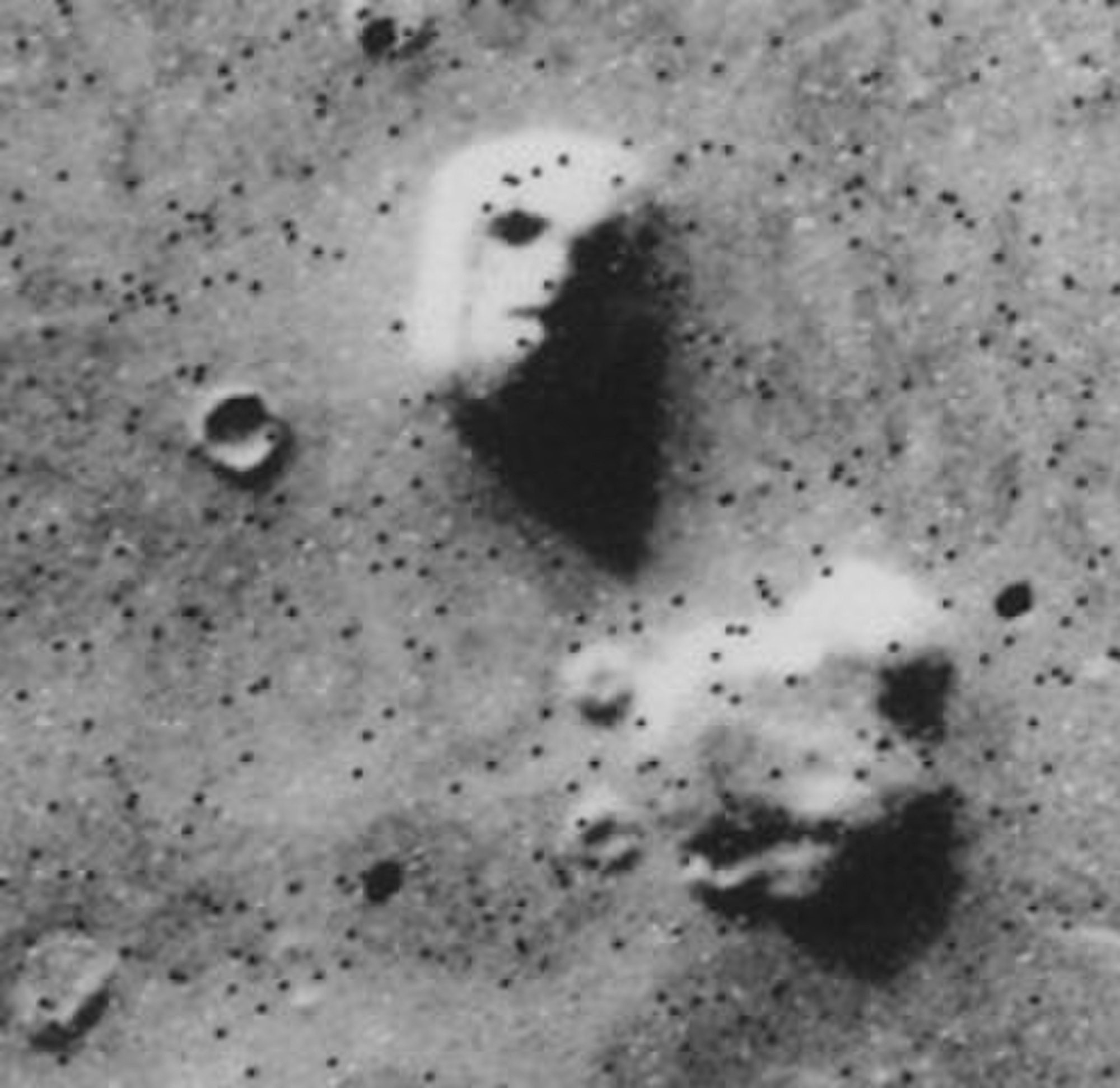
On July 25, 1976, NASA’s Viking 1 orbiter captured a globally famous photograph while surveying the Cydonia region of Mars. The low-resolution image revealed a Martian hill that, due to a specific angle of sunlight and a smattering of digital data dropouts, bore an uncanny, eerie resemblance to a giant human face staring directly into the cosmos. NASA immediately released the photo to the public, instantly sparking a massive worldwide pop-culture phenomenon.
The compelling second layer of the “Face on Mars” is its role as a premier case study in human psychology and scientific advancement. The image became a hallmark example of pareidolia—the human brain’s evolutionary tendency to find familiar patterns, particularly faces, in random shapes. When NASA’s Mars Global Surveyor returned to Cydonia in 1998 and 2001 equipped with high-resolution cameras, it revealed the “face” to be a completely natural, ordinary eroded mesa, demonstrating how advanced technology continually refines our understanding of the universe.
