
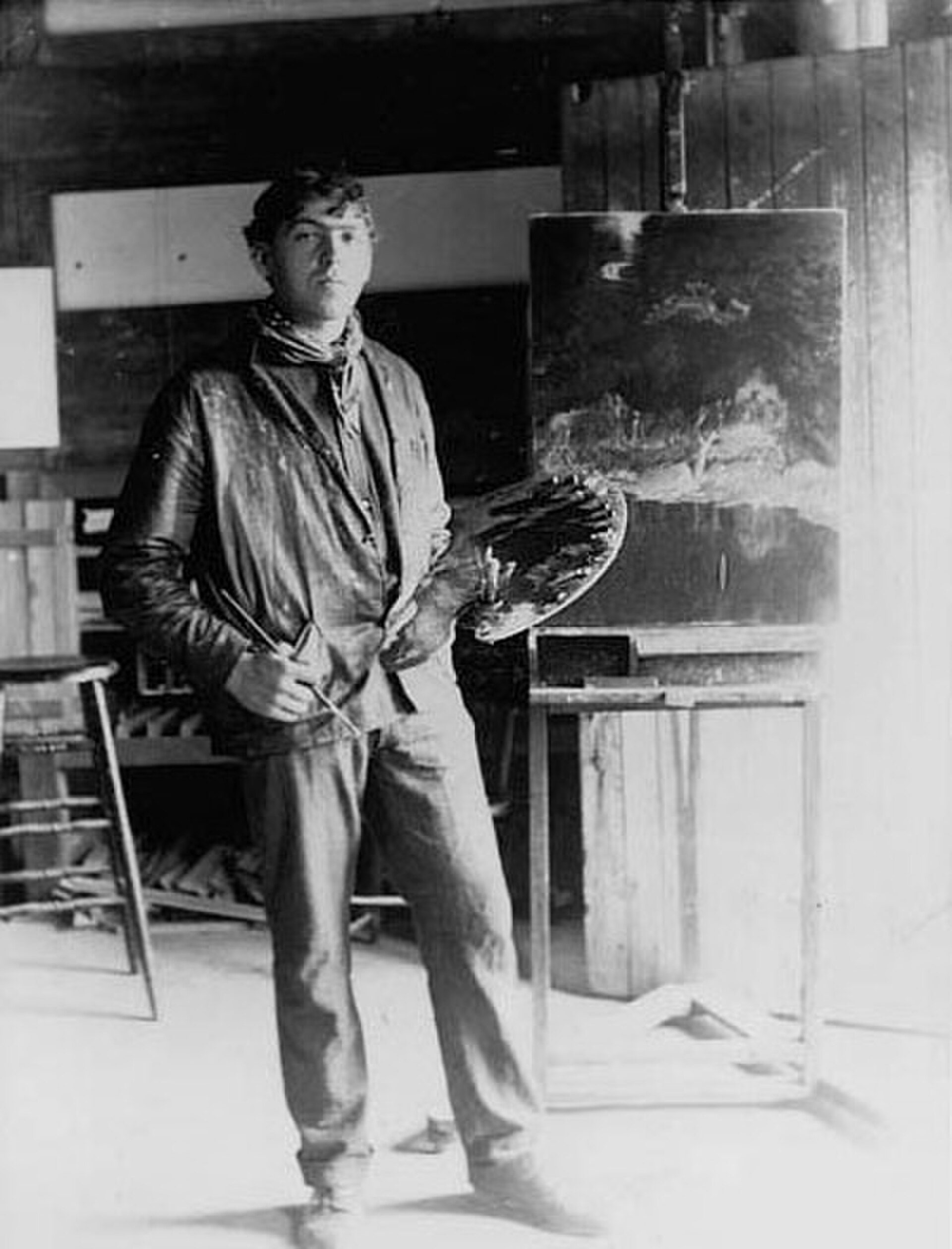
Born on October 22, 1882, in Needham, Massachusetts, Newell Convers Wyeth became one of America’s best-known illustrators. Raised on a farm in New England, he developed a lasting love of nature that informed both his illustrated adventures and his personal paintings. In 1902, he traveled to Wilmington, Delaware, to study under Howard Pyle, whose emphasis on dramatic composition and firsthand knowledge of a subject helped shape Wyeth’s approach. Between 1904 and 1906, Wyeth made three journeys to the American West, gathering experiences that brought conviction and physical presence to his frontier scenes.
His breakthrough in book illustration came in 1911, when Charles Scribner’s Sons commissioned him to illustrate Robert Louis Stevenson’s Treasure Island. The resulting 17 paintings combined forceful action, expressive characters, and striking contrasts of light and shadow. Their success began a long association with Scribner’s, followed by illustrations for such books as The Last of the Mohicans in 1919 and The Yearling in 1939. These images helped generations of readers picture the worlds of classic literature.
His subjects also included quieter encounters with nature. The Silent Fisherman, dated 1906 in the Brandywine Museum’s collection database and also known as The Lone Fisherman, offers a contemplative counterpoint to his scenes of danger and adventure. Rather than marking a clean break with dramatic illustration, it belongs to the broader range of subjects he explored throughout his career.
Credited with more than 3,000 paintings and illustrations for over 100 books, Wyeth nevertheless struggled with the distinction between commercial illustration and fine art. Alongside his commissioned images, he painted landscapes, still lifes, and portraits, while also earning a national reputation as a muralist. His legacy continued through a remarkably creative family, including his painter children Henriette, Carolyn, and Andrew, and his grandson Jamie. Across these different pursuits, his gift was consistent: making a painted scene feel like a world the viewer could enter.
