
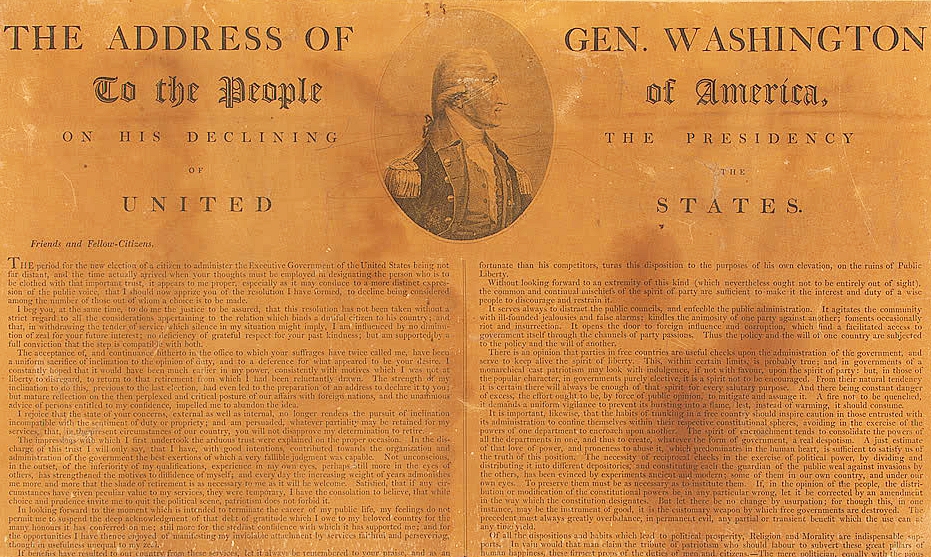
On September 19, 1796, President George Washington’s Farewell Address appeared in Philadelphia’s American Daily Advertiser. Having decided not to seek a third term, Washington did not deliver a public valedictory speech. Instead, he addressed the American people through a printed open letter. Prepared with substantial editorial and drafting assistance from Alexander Hamilton—and building on an earlier draft associated with James Madison—the address emerged amid intensifying domestic political division.
The document offered a series of warnings intended to preserve the young constitutional republic. Washington placed particular emphasis on national unity, calling the Union a principal support of American independence, peace, prosperity, and liberty. He urged citizens to resist sectional rivalries and to be wary of efforts that might weaken their attachment to the nation as a whole. Washington wrote that “it is of infinite moment” for Americans to recognize the immense value of their national Union to their collective and individual happiness, and to maintain a “cordial, habitual, and immovable attachment” to it.
Washington also warned against the destructive force of political faction, as well as long-term foreign entanglements. Although the address reflected the immediate pressures of the 1790s, its concerns about partisanship, regional division, and civic responsibility have kept it central to American political memory. The address became an enduring statement of Washington’s belief that liberty depends not only on institutions, but also on citizens’ willingness to sustain a shared political community.
Published 230 years ago, Washington’s parting appeal still raises a difficult civic question: what holds a diverse nation together?
On September 19, 1796, George Washington’s Farewell Address was published in Philadelphia—a parting plea to cherish the Union, not just for national strength, but for personal happiness. His words still ask: what holds us together? Image via Wikimedia Commons, no known restrictions
