
On the night of September 13–14, 1943, as the Salerno beachhead entered its fifth day, the U.S. Army’s 82nd Airborne Division carried out an emergency combat drop to reinforce the endangered Allied position in Italy. A powerful German counterattack had opened a dangerous gap between Allied forces and threatened the American sector with collapse.
Responding to an urgent request from Lt. Gen. Mark Clark, commander of Fifth Army, the 82nd Airborne rushed elements of the 504th Parachute Infantry Regiment—principally its 1st and 2nd Battalions, with the regiment’s 3rd Battalion absent—along with Company C, 307th Airborne Engineer Battalion, into action. About 1,300 men departed Sicily aboard C-47 transport aircraft for a night jump onto the Allied-held beachhead south of the Sele River.
Pathfinders went in before the main formation and activated homing beacons to guide the transports. On the ground, troops marked the small drop zone with a flaming T made from containers of gasoline-soaked sand. The first aircraft of the main lift reached the drop zone at 11:26 p.m. on September 13; additional troops arrived after midnight on September 14. For a night combat jump, the operation was remarkably accurate: most paratroopers landed within about 200 yards of the intended drop zone.
The reinforcements gave the hard-pressed beachhead trained infantry at a critical moment and provided a visible boost to Allied morale. The defense of Salerno depended on many factors—including the determination of Allied ground troops, naval gunfire, and airpower—but the emergency airborne drop helped stabilize the perimeter. It also became an important early demonstration of the ability of U.S. airborne forces to reinforce a threatened battlefield quickly.
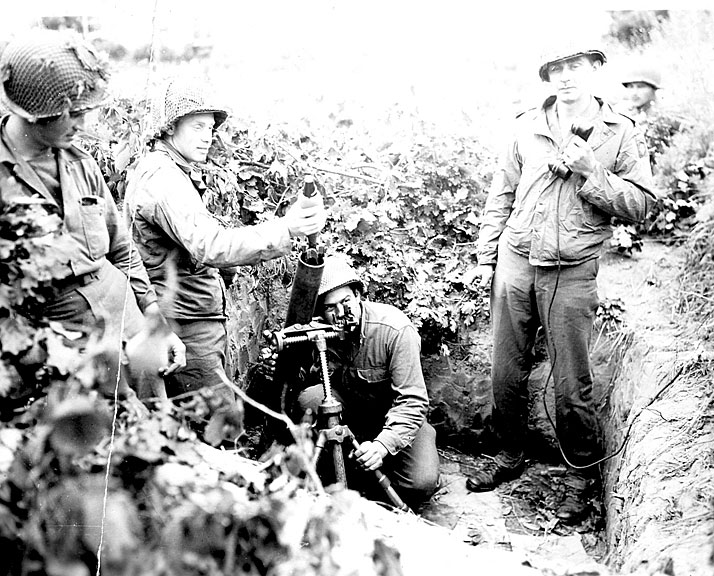
Image: Members of the 504th Parachute Infantry Regiment prepare to fire a mortar during the Italian campaign, September 1943. U.S. Army / Wikimedia Commons, public domain.
