
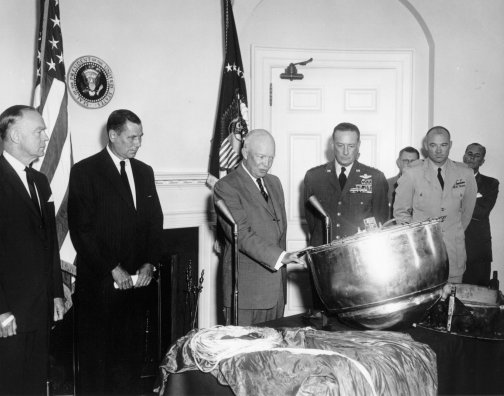
A photo of President Dwight D. Eisenhower inspecting the capsule of Discoverer XIII on August 15, 1960, that landed in the Pacific Ocean after orbiting the earth 17 times four days earlier.
The high-profile inspection on August 15th was a monumental, system-shaking triumph in the Cold War aerospace race, marking the first time humanity had ever successfully recovered an object sent into orbit. Ostensibly launched as a harmless scientific satellite, the Discoverer program was actually a top-secret cover for Project Corona—the United States military’s very first orbital reconnaissance system designed to photograph Soviet nuclear installations from space. Prior to this flight, multiple consecutive capsule recoveries had failed due to parachute malfunctions and telemetry errors, leaving American intelligence agencies completely blind.
The successful mid-ocean retrieval of the capsule by a specialized Navy task force provided a critical psychological boost to the Eisenhower administration following the public embarrassment of the U-2 spy plane shootdown earlier that year. By physically touching the gold-plated aluminum shell inside the White House, Eisenhower validated an extraordinary engineering leap that proved physical film could be safely dropped out of orbit and caught before it hit the ground. This historic milestone single-handedly unlocked the modern era of satellite surveillance, altering global military strategy by turning the vacuum of space into the ultimate intelligence-gathering frontier.
