
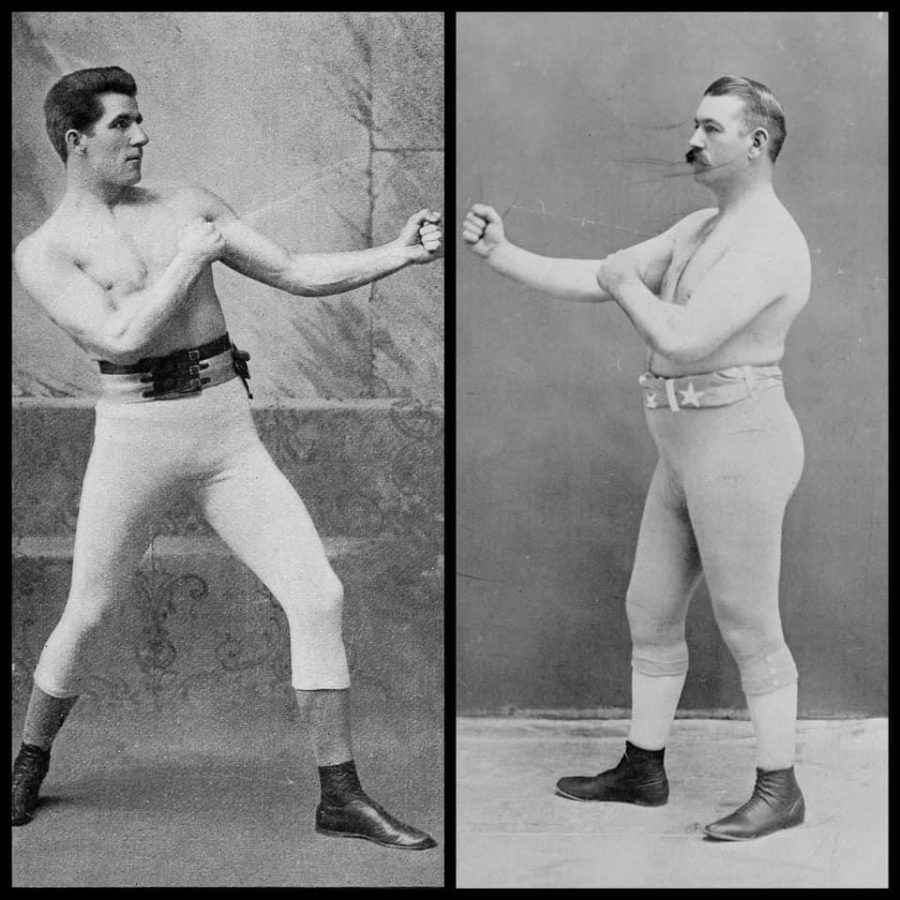
On September 7, 1892, professional boxing entered a new era in New Orleans, Louisiana. Challenger James J. “Gentleman Jim” Corbett defeated reigning heavyweight champion John L. Sullivan by knockout in the twenty-first round, capturing the world heavyweight title before a huge public audience at the Olympic Club. The result was one of the most consequential victories in the sport’s history: it elevated Corbett as the first recognized heavyweight champion of the modern Queensberry-rules era and made Sullivan the enduring symbol of boxing’s older bare-knuckle tradition.
The fight mattered not merely because a celebrated champion lost, but because it dramatized a wider transition already under way in prizefighting. The Marquis of Queensberry rules required the use of padded gloves, established three-minute rounds followed by rest periods, and barred the wrestling and grappling that had been central to earlier London Prize Ring–style contests. These standards made boxing more structured, more legible to spectators, and increasingly compatible with legal venues, organized promotion, and a growing professional sports culture.
Sullivan, known as the “Boston Strong Boy,” had built his reputation through overwhelming strength, toughness, and knockout power. He was the dominant heavyweight of the late nineteenth century and had become a national celebrity, but he represented an older style of fighting—one grounded in durability, aggression, and close-range physical force. Corbett, by contrast, represented the emerging ideal of the “scientific” boxer. He prepared methodically, managed distance, used lateral movement, avoided unnecessary exchanges, and relied on timing and defense as much as punching power.
For much of the contest, Corbett refused to give Sullivan the stationary target he wanted. He moved, jabbed, countered, and made the champion work to close the distance. As the rounds accumulated, Sullivan’s energy declined while Corbett’s conditioning and tactical patience became more valuable. In the twenty-first round, Corbett landed the decisive blow, knocking Sullivan out and ending his championship reign.
The contest did not instantly eliminate bare-knuckle fighting everywhere, nor was it literally the first heavyweight championship bout conducted under Queensberry rules. Sullivan himself had previously fought gloved championship contests. But Corbett’s win became the defining symbolic break between the old and new forms of the sport. It confirmed that the heavyweight championship—and, increasingly, professional boxing as a whole—would be associated with gloves, timed rounds, technical training, formalized rules, and commercially organized events.
Corbett’s triumph also changed the public image of the elite fighter. The new champion was not simply expected to be the strongest man in the ring. He was expected to be prepared, disciplined, mobile, tactically intelligent, and capable of turning athletic technique into a winning strategy. In that sense, Corbett’s defeat of Sullivan helped establish an archetype that would define twentieth-century boxing: the trained modern athlete whose footwork, conditioning, defense, and ring intelligence could overcome raw physical force.
More than a championship changing hands, Corbett versus Sullivan was a turning point in the history of organized sport. It marked the growing authority of codified rules over informal combat traditions and helped position boxing as a regulated, promotable, spectator-centered professional enterprise. The twenty-one rounds in New Orleans did not create modern boxing by themselves, but they gave the sport one of its clearest dividing lines—between the bare-knuckle past and the gloved, scientific future.
