
On October 2, 1918, during the Meuse-Argonne Offensive in France, Major Charles W. Whittlesey led a composite force of the 77th Division into the steep, wooded terrain around the Charlevaux Ravine. His advance depended on Allied units moving alongside him and protecting his flanks. But when neighboring French and American attacks stalled or fell back under intense German resistance, Whittlesey’s force pushed farther forward than its supporting units and was cut off by German troops occupying the surrounding high ground.
The trapped force became known as the “Lost Battalion,” although it was not literally a single battalion. It was a composite detachment built around Whittlesey’s 1st Battalion, 308th Infantry, with attached elements from other units. The often-cited figure of 554 men refers to Whittlesey’s original contingent; only 194 were ultimately able to leave the Argonne under their own power.
From the evening of October 2 through October 7, the isolated Americans endured a brutal siege. Pinned down by machine-gun fire, artillery and mortar bombardments, snipers, and repeated German attacks, they received no food, water, ammunition, or medical supplies despite efforts to reach them. A friendly artillery bombardment caused additional casualties. Wounded men were treated with improvised bandages, and the survivors scavenged ammunition from the dead and wounded as their supplies dwindled.
On October 6, the Germans sent a written demand for surrender. Whittlesey refused. He remained at his post and held his exhausted command together through five days of isolation, fighting, and failed relief attempts. His leadership became central to the unit’s survival.
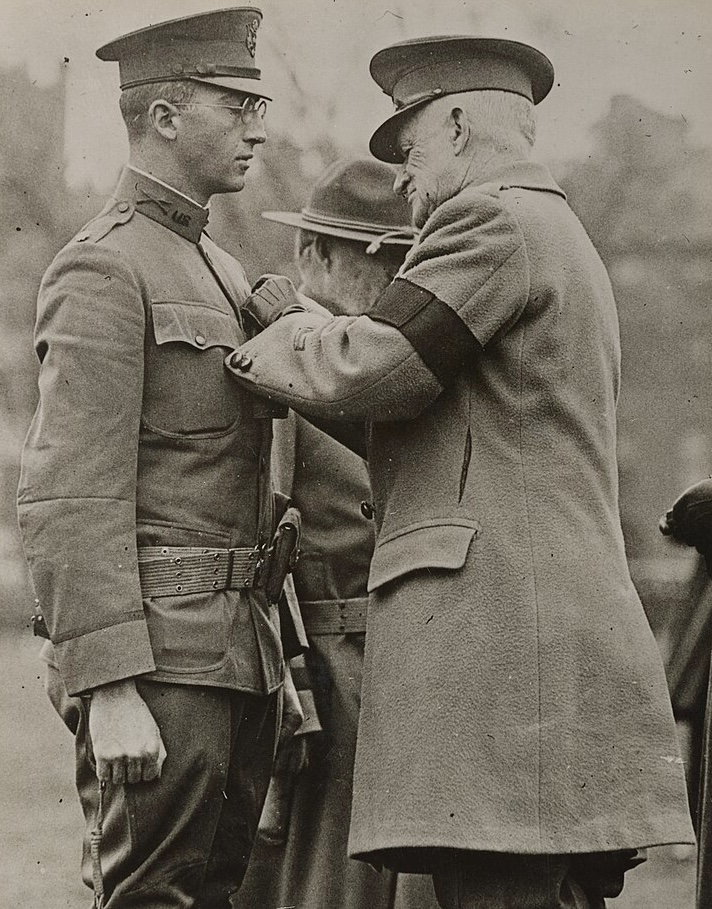
Relief forces reached the position on October 7. Of the 554 men commonly counted in Whittlesey’s original force, 107 had been killed, 63 were missing, and 190 were wounded; just 194 could walk out under their own power. Whittlesey returned to the United States as a national hero and received the Medal of Honor from Major General Clarence R. Edwards on Boston Common on December 24, 1918. Yet the experience appeared to weigh heavily on him for the rest of his life.
Whittlesey’s advance remains an enduring example of leadership under extreme pressure—not because the men were truly “lost,” but because they held their position after being isolated far beyond the reach of the main American line.
Image: Major General Clarence R. Edwards presents the Medal of Honor to Lieutenant Colonel Charles W. Whittlesey on Boston Common, December 24, 1918. National Archives; public domain.