
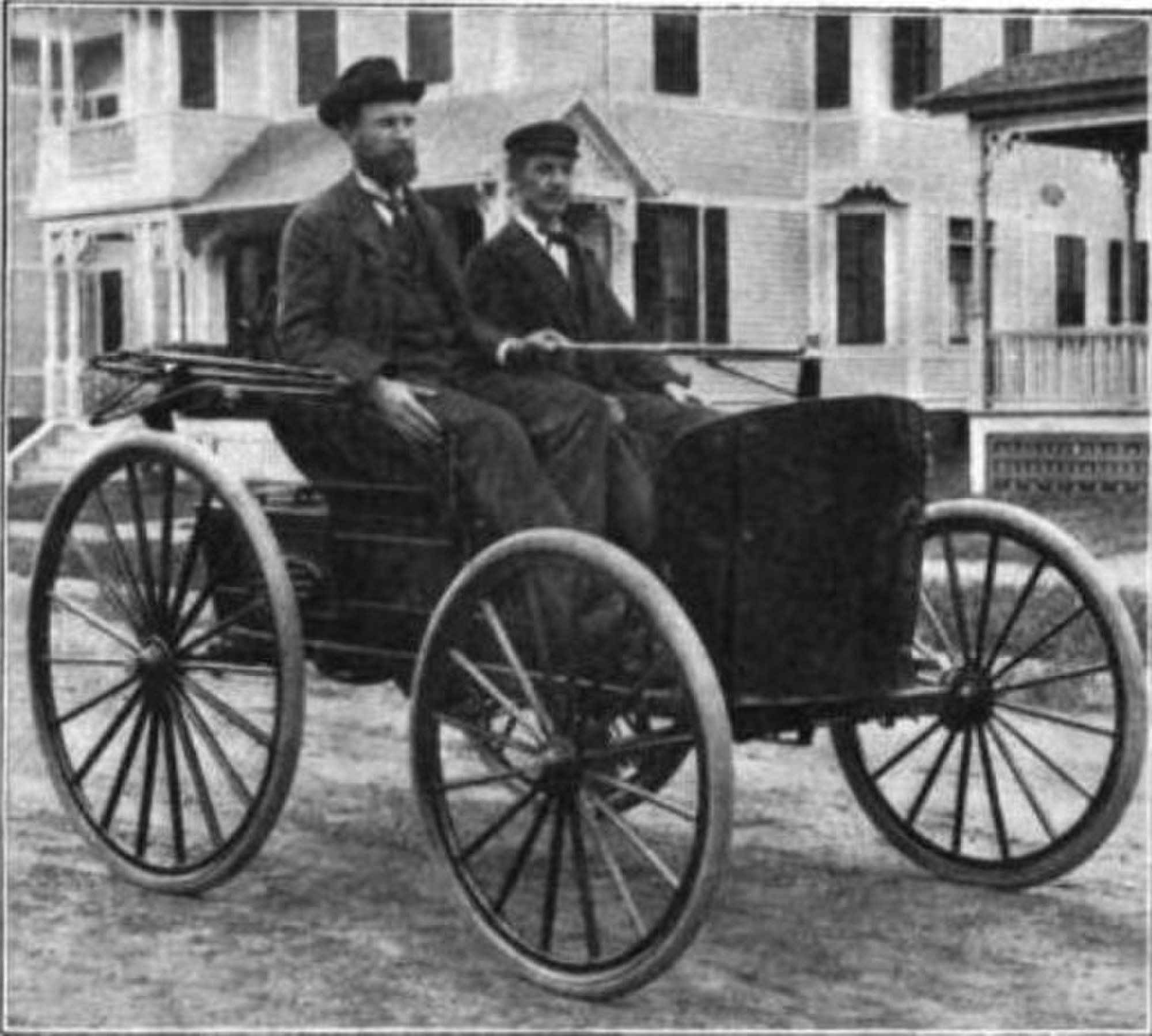
On September 21, 1893, Frank Duryea road-tested a gasoline-powered horseless carriage in Springfield, Massachusetts, after building it with his brother, Charles. The machine adapted a second-hand horse-drawn carriage with a single-cylinder gasoline engine, making it one of the earliest successful American-made automobiles. The Smithsonian records the September 21 test as a landmark early road trial, although accounts differ on the precise location and sequence of the brothers’ earliest runs.
The Duryeas’ experimental vehicle showed that an internal-combustion engine could propel a practical wheeled vehicle on public streets. Its design incorporated features including a spray carburetor, low-tension ignition, and a friction-drive transmission. Rather than claiming an uncontested “first,” historians commonly place the Duryea among the pioneering gasoline automobiles built in the United States during the 1890s.
The brothers’ work gained wider recognition in 1895, when Frank Duryea drove a later vehicle to victory in the Chicago Times-Herald race on November 28. The 54-mile contest from Chicago to Evanston and back is widely recognized as America’s first major automobile race. That same year, investment helped establish the Duryea Motor Wagon Company, an early U.S. manufacturer of gasoline automobiles.
The 1893 trial remains an important milestone in American transportation history: it was not the undisputed beginning of the automobile, but it helped demonstrate that a gasoline-powered car could be built and operated successfully in the United States.
Image: Charles and Frank Duryea, 1894, via Wikimedia Commons (public domain).
